Showing posts with label Hudson Lowe. Show all posts

Thursday, 7 April 2022

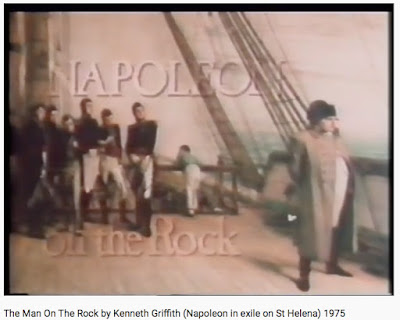
The Man on the Rock - Kenneth Griffith (1975)


On our recent visit to St Helena we were privileged to be able to watch this powerful performance by Kenneth Griffith on a large screen. It first appeared in 1975, but has long since been forgotten, and it was difficult to find a copy. We were surprised and pleased to find that it is now available on youtube

Click Here To View .

It was filmed on St Helena and one of my friends on the island remembers Griffith coming to the local amateur dramatic group on a number of occasions during his stay.

Griffith plays Napoleon's gaoler Sir Hudson Lowe as well as Napoleon, which is a remarkable achievement in itself. His portrayal of Lowe is at times rather amusing and after half a century and much scholarly activity still seems an accurate one.

Any recent visitor to St Helena will note how the presentation of the French Properties has greatly changed since the film was made.

It is very highly recommended viewing for anyone interested in the captivity of Napoleon.

Thursday, 17 March 2022

Sir Hudson Lowe and Antonomasia - A Review


Sir Hudson Lowe, Victime of St Helena by Michel Dancoisne-Martineau

This book, one of a series of 12, is only available from the Longwood House souvenir shop on the island of St Helena. It contains parallel French and English text, as well as numerous pictures, newspaper cuttings and historical documents. The author rivals Napoleon in his capacity for hard work, and has over the years done a tremendous amount of research on his subject, rather more than is normal for such a book, as the 369 footnotes testify.

From relatively humble origins, Lowe received the job of guarding the most illustrious person of his age, and probably of many ages, and this gave him an inflated sense of his own importance. He came to believe that he was at least Napoleon’s equal, and perhaps his superior. With an undistinguished military career, Lowe had gained for himself a reputation for good foreign language and writing skills. His promotion was based on his abilities as an administrator and an observer, on his loyalism and obedience, and on the fact that nobody of suitable rank could be found to carry out such an assignment.

The author provides an apt judgement on why Sir Hudson Lowe was such a good choice for the Lord Bathurst and the British Government.

“.. the man Bathurst needed to subject Napoleon to the petty restrictions, even humiliations, he wished to inflict on him, without exposing himself to the opprobrium of opposition and history. Two centuries after the events, the appointment of a civil servant reputed to be meticulous, undiscerning, quarrelsome, vain, petty, zealous and stubborn looks like a fool’s bargain. If one had to decide who was to blame, one should probably look to those who invited him to the table of the great and powerful.”

Flier for Exhibition at Plantation House, St Helena, cut short by decision of the present Governor's wife!

The book reveals a sound knowledge of the British or more accurately English society from which Lowe sprang: a highly ordered, corrupt society dominated by a small oligarchy, ruthless in its suppression of dissent and desirous of turning back the ideas of the French Revolution of which Napoleon had become the symbol. It correctly identifies Lowe as an ultra-loyalist Tory, whose political views would have been reinforced by his association with the absolutist continental rulers to whom he was often attached during the wars against Napoleon. He was in short the most loyal of subjects of George III and the Prince Regent, and of the aristocratic world in which he thought he had secured a foothold. In his entourage on St Helena he sought people with similar views to himself, and was most suspicious of those known to be sympathetic to the Whigs and to Napoleon.

The study takes issue with those who see Lowe as a vindictive gaoler as well as those who see him as the victim of cruel manipulation by Napoleon and his entourage. It paints a picture of a well meaning but flawed man, appointed to a job for which he was not suited, who let his sudden promotion rather go to his head, and who was never able to free himself from the delusions acquired from his appointment. Much of the material is new, particularly for the period after his return from St Helena when Lowe was never able to get a senior position that matched the St Helena appointment, and had to withstand increasingly unpleasant and often public shows of unpopularity, which the author describes as “mobbing”.

The most astonishing revelation of this study was the amount of wealth that Lowe gained from his five years in charge of Napoleon, despite losing a significant amount from fraud. As this book explains, this helped reinforce the delusion which was a feature of his conduct both on St Helena and after. In 1824 he continually changed his mind as to whether to accept the post of Governor of Antigua, and his frequent changes often appeared to be related to decisions of the local Assembly to lower and then raise the salary. Despite not taking the job he still submitted an account for £302 for expenses, around £27,000 in 2018 money! The author also reveals Lowe’s attempts to get back-pay from the East India Company as well as pay for the year after he left the island. The Company resisted, but for some reason the British Government in the person of Lord Bathurst acceded to his wishes.

Perhaps the most telling and amusing part is the account of his ten months long ostentatious overland journey with his family from Paris to Ceylon to take up his appointment as Lieutenant Governor, in the forlorn expectation that he would shortly thereafter receive the appointment as Governor. During the whole of this trip Lowe basked in the temporary title the Govt had given him of Lieutenant General of His Gracious Majesty, but he was not always as well received as he wished in the capitals of Europe. In Vienna the Emperor Franz refused to see him, and Metternich encouraged him to leave the city where Napoleon’s son then resided!

Among the belongings auctioned after his death was a lock of the King of Rome’s hair, the subject of over 1000 pages of correspondence while he was on St Helena, which had supposedly been destroyed. There were also other articles bearing inscriptions “N” and “Emperor” which would have got anyone severe penalties had they been written by anyone on the island during Lowe’s term as Governor.

Finally, I have learned a new word from this book, antonomasia, the use of a proper name to describe the characteristics of a person. According to Hazlitt (1826) a “Sir Hudson Lowe” is someone who appears

“ so much the creatures of the head and so little of the heart, they are so cold, so lifeless, so mechanical, so much governed by calculation, and so little by impulse …”.
Such was Lowe’s reputation that the term was even used in the House of Commons during Lowe’s lifetime.

This is an important, well researched book. It is a pity that it is so difficult to obtain.

ps. I also learned that Sir Hudson Lowe was a couple of centimetres shorter than Napoleon! The British propaganda about Napoleon's height is a subject I have often referred to over the years!.

Friday, 22 May 2020

The Pen is Mightier than the Sword: St Helena, March 1820


Front cover, "The political house that Jack built", 1819

In March 1820 a naval surgeon named McKenzie arrived on St Helena with a copy of the The political house that Jack built. (1) This pamphlet which was published by William Hone in the wake of the August 1819 Peterloo Massacre in Manchester, was to run to several editions and sell 100,000 or so copies.

McKenzie had, so he claimed, intended to show the pamphlet to Sir Thomas Reade, before giving it to an English resident on the island. Unfortunately he left it in a shop, and two British army officers found it and reported him to Sir Hudson Lowe.

Lowe immediately sent McKenzie aboard his ship and held him prisoner for 7 days, threatening to send him back to England and force him out of the Navy. Luckily for him there was no ship leaving for England, and so at the end of his confinement he was able to beg Lowe for forgiveness and secure his release. (2)

Hone was a fierce defender of the freedom of the press who had faced three separate trials on three days in December 1817, one of which was for libelling the Prince Regent.(3) He was acquitted in each trial, to great popular acclaim. Henceforth he was regarded as almost immune from prosecution whilst other radical journalists frequently found themselves in prison, and William Cobbett exiled himself in North America to avoid the same treatment.


Ruffians are abroad

William Hone was a friend of Hazlitt, and like him and many others did not subscribe to the Loyalist narrative about Napoleon. One of his earlier pamphlets had been Buonaparte-phobia (1815), which satirized the exaggerated anti-Napoleonic language of The Times , whose editor was henceforth referred to as Dr Slop.

The frontispiece of The "Political House that Jack Built" (top) carried a cartoon of Wellington, putting his sword on the scales of justice. The Waterloo man, as Hone described him, had been recruited into the Cabinet in late 1818, and his appointment was seen as a sign that the Government was prepared to use military force to put down those calling for reform. The Manchester massacre seemed to confirm this, and it almost immediately became known as "Peterloo".

These are THE PEOPLE all tatter'd and torn,
Who curse the day wherein they were born,
On account of Taxation too great to be borne,
And pray for relief, from night to morn;
Who, in vain, Petition in every form,
Who, peacably Meeting to ask for Reform,
Were sabred by Yeomanry Cavalry, who,
Were thank'd by THE MAN, all shaven and shorn,
All cover'd with Orders--and all forlorn;
The Man of course was the Prince Regent, a Whig in his youth, who had turned against his former political friends and had publicly thanked the troops who broke up the reform meeting in Manchester.


George Cruikshank's caricature of the Prince Regent

 
THE DANDY OF SIXTY, who bows with a grace,
And has taste in wigs, collars, cuirasses and lace;
Who, to tricksters, and fools, leaves the State 
and its treasure,
And, when Britain's in tears, sails about 
at his pleasure:
Who spurn'd from his presence the Friends of his youth,
And now has not one who will tell him the truth;
Who took to his counsels, in evil hour,
The Friends of the Reasons of lawless Power; 

In the poem Hone looked to leading Whigs to save Reform from Wellington and the repressive Tory Government:

This WORD is the Watchword--the talisman word,
That the WATERLOO-MAN's to crush with his sword;
But, if shielded by NORFOLK and BEDFORD's alliance,
It will set both his sword, and him, at defiance;
If FITZWILLIAM, and GROSVENOR, and ALBEMARLE aid it,
And assist its best Champions, who then dare invade it?

It is no wonder that a pamphlet such as this was not welcomed on St Helena at this time. Lowe and Reade were fierce Loyalists, determined to keep opposition newspapers off the island and especially from Longwood House, and naturally suspected anyone who showed any Whig or worse still Radical sympathies. On St Helena where the Governor's word was supreme, there was no recourse to the law to protect press freedom or individual liberties.
-------------------------------------------------
1. Jack was a synonym for John Bull. "This is the house that Jack Built" is a traditional English nursery rhyme.
2. The Morning Chronicle, May 20, 1820.
3. See also this post on Hone.

Saturday, 22 September 2018

St Helena 1815: The East India Company, Slavery and Religion


St Helena halfpenny bearing crest of the East India Company

The East India Company and St. Helena's leading families were naturally apprehensive about the impact the detention of Napoleon would have on their remote, congenial world. Sir Hudson Lowe the new Governor, although technically appointed by the Company, was a Crown nominee and a servant of the Government. His appointment brought UK politics one step closer.

From the 1790's the anti-slavery and evangelical movements had a major impact on UK politics, and with that came increased pressure on the East India Company for the licensing of missionaries to save the souls of the heathen.

Bowl c. 1820 bearing slogan used by anti-slavers from the 1790's

The Company was painfully aware of the changing political climate. It had had an uneasy fight to get its charter renewed in 1812, and had been forced to open up India to missionary activity. (1) In a long letter addressed to Lowe in 1815 it addressed the very topical issues of slavery and of religion. (2)

On the issue of slavery the Company could make a case for its enlightened policies : there was no slavery in India, and the ban on the import of slaves into St. Helena preceded the much celebrated 1807 UK Slave Trade Act by 15 years. But 23 years after the import ban, slavery was still entrenched on the island, and over a third of the population were slaves. (3)

Poster advertising sale of Slaves in Jamestown, 1829

Nevertheless the 1815 letter to Lowe played down slavery's importance : their numbers were comparatively small", they were slaves "only in name" and "every indulgence is extended to them consistent with the safety and wellbeing of the Settlement."

The letter also indicated that the Company had issued orders to free the slaves altogether, but to its regret " obstacles have presented themselves to the complete Emancipation. " This was probably a reference to the rearguard action of Robert Leech and Sir William Doveton, leading magistrates who both attested to the good character of a slave-owner indicted for the murder of a slave in 1815. (4)

On matters of religion the Company shared the concerns of the Anglican Establishment and the Lord Liverpool Government about the rise of religious enthusiasm and the threats to Anglican dominance. It appointed chaplains to inculcate morality, order and loyalty amongst its soldiers and civilian employees, but it viewed missionary activity as a threat to the stability of its empire.

The letter to Lowe devoted much attention to the religious and moral climate on St. Helena which it claimed was improving. It prided itself on the creation in 1811 of two schools under the supervision of one of the chaplains.

The observance and inculcation of Religion both by precept and Example at St Helena has constantly been an object of the Court’s unremitting anxiety in furtherance of which they have for several years past maintained an Establishment of two Chaplains concerning whose religious principles and moral character they were 
 well satisfied at the time of their Appointment, their ordinary duties, the regular performance of Divine Worship on Sundays in the Town and Country Churches, to visit the sick in the Hospital and the Inhabitants of the Island as occasion may require, and otherwise to deport themselves in a manner becoming the Clerical Character.

The Company was though very concerned that the expected influx of population to guard Napoleon would bring in more non-Anglicans.

The subversion of the established Church we should consider as an evil and incalculable magnitude and we cannot too strongly recommend that the maintenance of our Established Religion be an object of your especial attention and unceasing Solicitude.

Coat of Arms of the Diocese of St Helena, established 1859

On this the Company's wishes were carried out. Anglican control of St. Helena outlasted both the East India Company and the institution of slavery. Not until mid-century were the Anglican defences breached, by the Baptists: St Helena's one and only native born Governor, Hudson Ralph Janisch (1873-1884), the son of a German Lutheran immigrant brought to the island by Lowe and named after him, became a Baptist as a young man. (5)

Today there is some diversity of religion on the island, but the other older non-conformist denominations, the Quakers, Methodists, Presbyterians, Congregationalists and Unitarians, have never established a presence there. As in England half a century ago, the overwhelming majority of Saints identify themselves as Anglican, but relatively few are regular churchgoers. (6)

The Saints' Anglican identity is accompanied by a strong loyalty to Crown and mother country. The continuous cycle of disappointments and the dissatisfaction that constitutes the experience of many islanders seems not to have weakened this loyalty. Their approbation is however, not so often given to the representatives of British authority on the island, from the Governor down.
-------------------------------------------------------------
1. The Anglican Establishment, closely intertwined with Tory/Loyalist politics, was however concerned not so much with saving souls as with maintaining the established social order. These aims seemed to be threatened by the growth of religious dissent and the associated campaigns to remove civil disabilities from Roman Catholics and Protestant non-conformists, as well as the campaigns for universal suffrage. Penelope Carson, The East India Company and Religion, 1698-1858 (The Boydell Press, Woodbridge, 2012) pp 117-118.
2. To Sir Hudson Lowe from the Court of Directors of the East India Company, East India House, 10th October 1815.
3.The letter to Lowe gave the full breakdown of the population - European Inhabitants 736,Garrison (Officers included) 891, Free Blacks
 420, Slaves
 1293, Chinese Labourers 247. Total 3587
4. The death of Leech and the sidelining of Doveton paved the way for the partial abolition that Hudson Lowe was able to declare in 1818. But slavery still remained an essential part of life on the island, most of the European families continued to own slaves, and it was not finally abolished until 1834.
5. For a history of the first Baptist missionaries on the island see Baptist Pioneers of St Helena.
6. According to the 2017 Social Attitudes study only 15% of the UK population now describes itself as Anglican, half as many as in 2000. 50% of the UK population describes itself as having no religion.

Sunday, 11 March 2012

Thomas Moore: "To Sir Hudson Lowe"


Thomas Moore, Irish Poet (1779-1852)


A friend of Lord Byron and of Lord John Russell, the future Whig Prime Minister who had visited Napoleon on Elba, Thomas Moore published the poem, "To Sir Hudson Lowe" in the Examiner, a radical newspaper, on 4th October 1818.

It reflects the criticism already prevalent in England in Whig and Radical circles about Napoleon's treatment on St Helena, and contrasts the greatness of Napoleon with his captors who are likened to the Lilliputians in Swift's Gulliver's Travels.

Sir Hudson Lowe, Sir Hudson _Low_,
(By name, and ah! by nature so)
As thou art fond of persecutions,
Perhaps thou'st read, or heard repeated,
How Captain Gulliver was treated,
When thrown among the Lilliputians.

They tied him down--these little men did--
And having valiantly ascended
Upon the Mighty Man's protuberance,
They did so strut!--upon my soul,
It must have been extremely droll
To see their pigmy pride's exuberance!

And how the doughty mannikins
Amused themselves with sticking pins
And needles in the great man's breeches:
And how some _very_ little things,
That past for Lords, on scaffoldings
Got up and worried him with speeches,

Alas, alas! that it should happen
To mighty men to be caught napping!--
Tho' different too these persecutions;
For Gulliver, _there_, took the nap,
While, _here_, the _Nap_, oh sad mishap,
Is taken by the Lilliputians!


Thursday, 1 March 2012

An American at Waterloo: The DeLanceys, Wellington and Hudson Lowe


Colonel Sir William Howe DeLancey, KCB (1778 - 1815)

Born into a wealthy New York Loyalist family, originally French Huguenots from Caen, Colonel DeLancey was named after William Howe, Commander in Chief of the British forces in America, who resigned in the year DeLancey was born, and to some extent became a scapegoat for defeat.

After the War the Delancey family property was sequestrated, and most moved to Beverley in Yorkshire. William entered the army in 1892, obtained his commission at 15, and served with distinction during the Peninsular War. Throughout his military career he was known by colleagues as “The American”.

Colonel DeLancey was highly regarded by Wellington who refused to accept command in the Belgian campaign against Napoleon unless he could appoint him in place of Hudson Lowe, whom he disliked. Wellington's unwillingness to have Hudson Lowe was made clear by Major-General Sir H. Torrens in a letter to Earl Bathurst, the Secretary of War,
I shall communicate fully with the Commander-in-Chief upon the Duke of Wellington's wishes respecting his Staff ... As you were somewhat anxious about Sir Hudson Lowe, I must apprise you that he will not do for the Duke." (1)

DeLancey was duly appointed deputy quartermaster-general of the army in Belgium. Sir Hudson Lowe was offered command of the British troops in Genoa and then, whilst in the south of France in August 1815 was appointed to be Napoleon's gaoler on St Helena.

On meeting Sir Hudson Lowe for the first time Napoleon was horrified, and described his appointment as an insult. Maybe he was right!

DeLancey was seriously wounded at Waterloo whilst talking to Wellington. He was nursed by Magdalen, his bride of a few weeks, who was believed to be the inspiration for the character, “Lucy Ashton” in Sir Walter Scott's 1819 novel, The Bride of Lammermoor. He died of his wounds a little over a week later, a serious loss to His Majesty's service, and to me, said Wellington.

A few months later, shortly before embarking for St Helena, Sir Hudson Lowe married his widowed sister, Susan DeLancey Johnson. (2) Whilst on St Helena she became generally unpopular with all who come in contact with her, drank too much, made Sir Hudson's life a misery, and as was the lot of married women in those days, bore children at fairly regular intervals: Hudson (1816), Clara Maria Susanna (1818) and Edward William Howe de Lancey Lowe (1820). She died in Hertford Street, Mayfair, London, on 22 August 1832.

The Lowes' third child, Edward William Howe de Lancey Lowe, named after the uncle who had perished after Waterloo, was himself to have a distinguished military career. He married a daughter of Basil Jackson, who had been on Wellington's staff at Waterloo, had accompanied Hudson Lowe to St Helena, acted as his spy at Longwood, and in a combination of amatory and espionage pursuits had followed Albine de Montholon to Brussels when she left St Helena in 1819.

---------------------------------------------------------------------

1. Major-General Sir H. Torrens to Earl Bathurst, Secretary for War, dated Ghent, 8th April 1815, quoted in introduction p. 11 to A Week at Waterloo in 1815, Lady De Lancey's Narrative , Edited by Major R.R. Ward, London 1906,
2. Lady Lowe's first husband, William Johnson had died in 1811. He too came from a New York loyalist family which had relocated to Canada. Lorenzo Sabine, Biographical Sketches of Loyalists of the American Revolution Volume 2, pp 574-582.

Monday, 20 June 2011

The 20th Foot and a Gift from Napoleon - The Fusilier Museum Bury


The Fusilier Museum in Bury has a small but priceless collection related to the last days of Napoleon. The centre piece is the three volumes of Coxe's Life of Marlborough, the gift of Napoleon to the 20th Regiment, which caused so much consternation to the Governor, Sir Hudson Lowe, and so much trouble to Captain Lutyens, the orderly officer at Longwood.


There are also a number of other items on view, including the medals of Dr Arnott, the last British doctor to attend Napoleon on St Helena, and the tunic he wore when attending him.


This tunic, and the picture of Arnott (below) were apparently rescued from the ruins of the home of a descendant of the Arnott family after the Lockerbie bombing in 1988, and but for that atrocity these items might never have been recovered.


Arnott, Archibald, M.D. (1771-1855). Surgeon to the 20th Foot Regiment, he was called to attend Napoleon on April 1st, 1821 and continued to attend him until his death on May 5th.

Whatever his limitations as a doctor, Arnott got on well with Napoleon.

During one of their conversations Napoleon praised the men of the 20th Foot and said that he would make them a gift of Coxe's Life of Marlborough.

The three volumes of this book were subsequently put in Captain Lutyens' room without explanation, presumably by St Denis.

On our visit we were privileged to be able to examine the famous books, and to photograph the three words, "L' Empereur Napoleon", which were like a red rag to a bull to Hudson Lowe.

Volume Two of Coxe's Life of Marlborough with three fatal words inscribed at the top. (Click to enlarge)


The inscription, almost certainly made by St Denis, who acted as Librarian at Longwood.


The books were returned to Longwood, although later the 20th Regiment was allowed to receive them, and for some time thereafter they were proudly kept in the officers' mess.

Happily Napoleon, in the last stages of his final illness, was not informed of what he would surely have regarded as one of the most hurtful of many insults. Even William Forsyth, Hudson Lowe's most faithful defender, conceded that "Napoleon's kindly meant present might, under the circumstances have been accepted. .. nor was there much likelihood of a British regiment being seduced from its allegiance by adding to its library a few books, the gift of Napoleon."

Blamed for his failue to return Napoleon's gift, Captain Lutyens was removed from his post. A decent man whose loyalty was unimpeachable, the incident was for him a disaster which must have overshadowed the rest of his short life.

Lutyens, Captain Engelbert (1784-1830). Orderly Officer at Longwood (1820-1821).

Member of a family which had come to England from Hamburg in 1745, and which was to produce one of Britain's best known architects.

Suspected by Hudson Lowe and Thomas Reade of being too friendly with the French at Longwood, honestly reporting the deterioration of Napoleon's health from November 1820, and very uncomfortable about being required to spy on Napoleon during his last illness, Lutyens had previously asked to be removed from Longwood at the end of December 1820.


For Captain Crokat, who replaced Lutyens at Longwood and subsequently had a very successful career and lived to the age of 90, it proved a very lucky break.

Crokat, William (1789-1879).

Having replaced Lutyens as orderly officer at Longwood he was given the honour of taking the news of Napoleon's death to London, for which he received the sum of £500, a large amount in those days.

He was also promoted to Major, ahead of Lutyens.

Lutyens, after a lengthy process was successful in getting his own promotion to Major backdated to 1821, as clear a sign as possible that the Army recognised that he had been wrongly treated.


Crokat whose bust is in the Fusilier Museum, ultimately rose to the rank of General,


and was one of the very few people who served on St Helena during Napoleon's captivity who can be said to have had great success afterwards.

Finally a note about the disputed books. Contrary to what has been written in a number of published accounts, these were the gift not of Captain Robert Cavendish Spencer, who happened to be on St Helena at the end of 1820, but of Lord Robert Spencer, the youngest son of the 3rd Duke of Marlborough. The books apparently had been sent via Lady Holland, at the centre of that group of Whigs who were opposed to the Government's treatment of Napoleon, and who sent many books to St Helena for Napoleon.

Allegedly Count Bertrand and/or his wife provided a French translation of Marlborough's biography for Napoleon. This translation, if it existed, has as far as I am aware never been found.

My thanks to Paul Dalton of the Fusilier Museum, and to Albert Benhamou, without whose help this blog would not have been possible.


Thursday, 31 March 2011

"Veritas" and "Sultana" or How Lady Lowe Almost Met Napoleon : A Case Study in Flattery?


MONTHOLON, Charles Tristan, Comte de (1783-1853), despite the departure of his wife Albine, he remained with Napoleon until his death and was, the servants apart, the only resident of Longwood House to do so.

Nowadays he is the prime suspect for poisoning Napoleon among those who subscribe to that theory.

For Gorrequer he was simply "Veritas", suggesting that he was plausible but also that what he said should not perhaps always be taken at face value.


LOWE, Susan DeLancey, Lady (1781-1832). The widow of Colonel William Johnson who died in battle in 1811, she had two teenage daughters, Susanna and Charlotte, of whose beauty she was very proud. Her father was Colonel Stephen DeLancey, a New York Loyalist who had moved to England after the American Revolution. With that background it is hardly suprising that she disliked Napoleon and all he was deemed to stand for.

Susan Johnson had married Sir Hudson shortly before they came to St Helena. For Lowe, who was over 10 years older (he was the same age as Napoleon) it was the first experience of matrimony, although he had had a mistress in Genoa who bore him two children.

Unfortunately there do not seem to be any images available of Lady Lowe, so we shall have to make do with a verbal picture given by Sir Henry Russell:
"a large, showy-looking woman of about forty, who has been handsome, with an air of fashion about her, but who is too highly rouged and too décolletée."
(1)
To Gorrequer she was "Sultana": a lady who considered herself at the apex of St Helena society, was never shy of voicing her opinions, and made life difficult for most of those who shared Plantation House with her, including Sir Hudson Lowe and most certainly Gideon Gorrequer. According to Russell again: " [she] had a great deal to say and very little reserve in saying it". (2)

Apparently whilst on St Helena she took to the bottle, which in the circumstances is perhaps understandable, and there were rumours also of a lover, Captain Den Taaf, although one gets the impression that not to be suspected of having a lover might almost have been considered an insult on the island at that time.

Lady Lowe of course never met Napoleon, although towards the end of Napoleon's life she had some limited social contacts with Mme Bertrand.

Anyway, on re-reading Gorrequer's diary I was struck by the following revealing entry, made after the death of Napoleon when there was a degree of amity between the residents of Longwood and those of Plantation House.

"Sultana boasted that Veritas [Montholon] had told her that our Neighbour [Napoleon] was once prepared and dressed on purpose to go out and meet her, when she went up in consequence of Veritas having promised her at the races to show her the grounds."

Lady Lowe blamed the orderly officer and then the Bertrands (particularly Madame Shrug as Gorrequer referred to her) for not telling Montholon that she had arrived and thus depriving her of the opportunity to meet their neighbour:
".. Veritas said that had he known she was there, he would have gone immediately to receive her and procure her a sight of Neighbour. That he added had she seen and conversed with him, she would easily have brought about everything and restored a good understanding between Mach and him. In fact her meeting Neighbour was all that was wanted .

The idea of Lady Lowe as a peacemaker is shall we say an interesting one. Perhaps Montholon really believed it, but he was not finished.
Veritas told her also that Neighbour had been looking at Cadetta [Lady Lowe's daughter] through the window, and admired her much, saying she was very pretty (all this was said before Cadetta). She believed she said that Madam Shrug prevented her meeting Neighbour for fear she might supplant her. She was jealous of her being introduced to him, and feared he would be making a present to herself and figli, which would be depriving Madame Shrug and her figli of them. It was in fact her apprehension that Sultana would put her (Mme Shrug) nose out of joint. Veritas had begged her permission to send her presents from Paris, bonnets etc., and pressed her to pay them a visit at Paris, and to consider him entirely at her commands for any commission she might desire to have executed there.


Then came Montholon's coup de grace:
That he said that he understood Mach was to go out as Governor General to India, and that he thought it very likely etc. This made Mach cock up his ears, and a suffusion of self complacency and consciousness of meriting it spread over his countenance, and he appeared quite delighted at the prospect. "


Quite how Montholon would have been privy to British Government thinking on colonial appointments is far from clear, but the gullible Sir Hudson, never to get another post of similar standing to that held on St Helena, was all too ready to believe him.

Gorrequer concluded with a comment about the inconsistencies of Lady Lowe:
Sultana was quite in rapture at Veritas' politeness, he was so pleasant, so amiable, so clever and gentlemanly, after all the abuse she had so frequently lavished on him!!(3)


Gorrequer's diary is full of such gems. Had he been prepared to tidy it up and publish it in his lifetime he would have made a fortune, at a cost probably of time and money spent in the Law Courts and of being outcast from polite society.

I often think what a pity it was that that distinguished scholar of the captivity, Arnold Chaplin was never able to get his hands on the diary. He knew about its existence and in A St Helena Who's Who quoted extracts from the judgement in the Court of Chancery which at that time prevented anyone from reading it. He concluded that it was doubtful that its contents would ever be revealed. (4) Little over a decade after his death the judgement of the Court was overturned by Act of Parliament.
---------------------------------------------------------------------------
1. Arnold Chaplin, A St Helena Whos Who (London 1919) pp 95-7.
2. Ibid .
3. 26 May 1821, St Helena During Napoleon's Exile, Gorrequer's Diary, pp 240-241
4. Chaplin p. 78-9


Friday, 25 February 2011

Gorrequer's Diary

Major Gideon Gorrequer (1781-1841), aide-de-camp and acting military secretary to Hudson Lowe on St Helena.

Gorrequer met Lowe whilst serving in Sicily and the Ionian Isles, and was asked to accompany him to St Helena, for which his fluency in French and Italian was an ideal qualification. He arrived with Lowe in 1816, and remained until after Napoleon's death. A lifelong bachelor, we know little of Gorrequer's private life. Along with Denzil Ibbetson he ran the amateur dramatics on the island during the captivity.

Of Huguenot stock, Gorrequer joined the army at 16 as an Ensign, and was promoted to Lieutenant (1897), Captain (1804), and Brevet Major (1814).

One of the gripes that comes over in his diary was the lack of appreciation of his hard work, his feeling that Ibbetson and others were more highly regarded for doing much less, and his suspicion that Lowe, encouraged by Sir Thomas Reade, was not throwing his weight behind Gorrequer's further preferment.

Gorrequer was however, finally promoted to Lt Col in 1826, possibly because of his agreement to support Lowe in the case against O'Meara that never actually came to court.

For many years his papers, including his diary were locked away in the Court of Chancery, where they remained until 1958.

It is doubtful if Gorrequer ever intended his diary to be read by others. He was always very cautious abut expressing his opinions, and would never talk about his experiences on St Helena afterwards, but a number of people on the island, including Lowe and Sir Thomas Reade, probably suspected that he was, as Mrs Thatcher might have put it, "not one of us".

One conversation with Lowe and Lady Lowe about Napoleon on 10th June 1818 might well have raised Lowe's suspicions:
"Donna [Lady Lowe] pitying the situation of B. [Bonaparte] and saying he really was to be pitied, contrasting his former situation with his present, and Sir H. [Lowe] saying he deserved more contempt than pity which gave rise to a lengthened reasoning between them. Both looked at me alternatively, as they spoke, and as if engaging me in conversation. I observed that something must be allowed for the personal feelings of a man who (as he said, trusting to the generosity of the British nation and expecting a refuge in England) had delivered himself into the hands of the English and instead of an abode in England, had found himself fixed at St. Helena. " (1)

A rash comment for the normally guarded Gorrequer, who was well aware of the suspicion that fell on those who were thought to have any sympathy for the inhabitants of Longwood:
"When Madame Shrug [Madame Bertrand] sent the list, his observation that C-ns and Pear_n [Cairns and Pearson] were objectionable characters to visit there. No man in the Island had any business to have any opinion but himself about the people of Longwood, and much less on his own actions or duties here."
Gorrequer was himself instructed to tear a leaf out of a book sent for Napoleon by a future Prime Minister because of something that he, Lord John Russell, had written on it. (2)

One of the interesting features of the diary is the use of nicknames, which are today a feature of St Helena, but were presumably used by Gorrequer to disguise identities in case anyone accidentally read his scribblings. Amongst the often humorous names he used were
Mach. - (Machiavelli) - Hudson Lowe
Constipation - Colonel Charles Nicol
Denzil Periwinkle - Denzil Ibbetson
Nincumpoop, Ninny - Sir Thomas Reade (also other names)
Old Brick and Mortar - Major Anthony Emmet (3)
Saul Sapiens - Saul Solomon
Shrug - Count Bertrand
Sultana or Donna - Lady Howe
German /Teutonic - William Janisch, clerk to Lowe
Neighbour or Vicino - Napoleon
Weeping Willie - Sir William Doveton
Veritas - Count Montholon
Yam Maggiore Long Shanks - Major Hodson (nicknamed Hercules by Napoleon).

Since the publication of Gorrequer's diary it has been virtually impossible to mount a serious defense of Sir Hudson Lowe. Gorrequer's own remarkably modern sounding conclusion on Mach (Machiavelli) as Gorrequer usually referred to him, has been recently quoted by Dr Howard, and is worth repeating:
" Mach is but a machine - he is just what his nature and circumstances have made him. He slogs the machine which he cannot control. If he is corrupt, it is because he has been corrupted. If he is unamiable it is because he has been marked and spitefully treated. Give him a different education, place him in other circumstances, and treat him with as much gratefulness and generosity as he has experienced of harshness, and he would be altogether a diferent nature. A man who would be anxious to be loved rather than feared; and instead of having the accusation of being a man who was satisfied to spread around him anguish and despair, one who has an instinct for kindness." (4)
Less well noted was Gorrequer's comment about Lowe's "contempt of men generally held clever". (5) This was consistent with his refusal to admit that Napoleon had any qualities above the ordinary,
"He frequently said he did not consider our Neighbour [Napoleon] as a man of superior mind or talent, or a man of judgement. He pretended to hold him quite cheap." (6)
and with his refusal to acknowledge to an incredulous Lord Byron at Holland House in 1815, that Napoleon had any special talent as a military leader. Some have claimed that Sir Hudson Lowe certainly regarded himself at least as Napoleon's equal, and Gorrequer noted how he looked for any confirmatory evidence of his beliefs however fragile such evidence was: "Mach's readiness and eagerness to hear any little nonsense to the prejudice of our Neighbour and Shrug and his wife without desiring, or trying to analyse it for fear it might be found false - and communicating such stuff to Big Wigs." (7)

If Sir Hudson Lowe comes out badly in Gorrequer's diary, so also does Lady Lowe, whom Gorrequer detested, and so does Sir Thomas Reade, perhaps the real eminence grise of St Helena. Those are issues for another day.
-------------------------------------------------------------------------
1. St Helena During Napoleon's Exile, Gorrequer's Diary , James Kemble (London 1969), p. 67
2. [End of 1819?] Gorrequer p. 153
3. Emmet was in charge of the construction of New Longwood House.
4. Gorrequer p. 267
5. 20 July 1818, Gorrequer p. 70
6 6th May 1821, Gorrequer p. 233
7. 14 Feb 1819 Gorrequer p. 116

Monday, 11 October 2010

The Doctor, the Admiral and His Mistress: It is not at all necessary to be polite to the General.


Dr John Stokoe. Born Ferryhill Durham 1775. Entered navy in 1794 as Surgeon's Mate.

A distinguished record of service in a number of naval engagements including Trafalgar.

Nearing the end of his career as a ship surgeon, he agreed in 1817 to take a three year posting to St Helena. Stokoe set out for St Helena on H.M.S. Conqueror in 1817.

I thought that I should see the great man and probably have the honour of conversing with him - little did I think at that time that the honour would be so dearly purchased! (1)


He married late in life, but was predeceased by his wife and two daughters. He died of apoplexy in 1852.

Vice-Admiral Robert Plampin (1762– 1834). A member of the Suffolk squirearchy, he was born at Chadacre Hall near Bury St Edmunds. (2)

He reminds me of one of those drunken little Dutch schippers that I have seen in Holland, sitting at a table with a pipe in his mouth, a cheese and a bottle of geneva before him. - Napoleon

Admiral Plampin is a timid man, whose one wish is to live in peace and meddle with nothing. He has seen Bonaparte once, and made no impression upon him. Count Balmain

The son of a naval officer, he had joined the navy at the age of 13, and rose steadily through the ranks. He had spent time in France and was admired in the navy for his language skills. He was survived by his wife Fanny, who died in 1864.

Plampin was also on H.M.S. Conqueror, going out to replace Sir Pulteney Malcolm as commander of the naval forces stationed on St Helena. Malcolm, who had had a cordial relationship with Napoleon, had already clashed with Hudson Lowe.

The Late Arrival on H.M.S. Conqueror

After the ship left Portsmouth it stopped off the Isle of Wight to pick up a lady. A most unorthodox procedure!

As soon as the Admiral landed on St Helena he went to Plantation House leaving his "wife" on board ship. He then installed her at the Briars. She was never received by Lady Lowe and the "court" at Plantation House.

According to rumours, which were always plentiful on St Helena, the lady did not restrict her favours to those of the rank of Admiral. The upright were scandalised, and from the pulpit the Rev Boys condemned the behaviour and its condonement. There was talk that she would be sent back to England, and that the Admiral would doubtless soon follow in disgrace.

This however, did not happen. The lady remained, the Admiral served out his three year posting, the Rev Boys shut up, and Hudson Lowe had a very compliant Admiral to deal with. As he reported to Bathurst:
Admiral Plampin seems to have decided to attempt no interference whatever. If he took any steps, it would be in order to assist me. (3)

With Plampin's acquiescence Lowe set about isolating the inhabitants of Longwood, and in particular discontinuing Sir Pulteney Malcolm's practice of taking newly appointed officers to meet Napoleon.

For Stokoe this was to prove a very sad end to his career. He met Napoleon only five times, but in doing so incurred the enmity of Hudson Lowe and the obsequious Plampin, and was finally court martialled and dismissed from the Navy.

Dr Stokoe and Napoleon: "They will only believe he is ill when they find him dead on his bed"

Stokoe's first meeting with Napoleon came when he was introduced during a visit to O'Meara in the autumn of 1817. They got on well, and Napoleon even offered to assist him in winning the hand of William Balcombe's eldest daughter - which according to another St Helena rumour was his desire!

The next day Stokoe reported the visit to the Admiral, who told him that he ought to have refused to speak to Napoleon, and that it was not necessary to be "polite to the General". (4) He then issued an order forbidding any naval officer speaking to Napoleon without the Admiral's prior consent.

Aware of the problems for any doctor attending Napoleon in the climate of suspicion and fear that existed on St Helena, Stokoe turned down a request to give a second opinion on Napoleon's health in July 1818. This also appeared to meet the Admiral's disapproval. He further incurred the wrath of Hudson Lowe by refusing to sign a letter indicating that the refusal was because of his lack of confidence in Dr O'Meara.

Then there was the awkward case of the letters destined for O'Meara but sent to Stokoe in an attempt to avoid their being intercepted by Plantation House. This was William Balcombe's suggestion, and Stokoe had no foreknowledge of it, but obviously it did him no good. To be considered a friend of O'Meara, who had by the time the letters arrived been forced off the island by Hudson Lowe, was an unfortunate position for anyone to be in on St Helena. One letter from Balcombe to Stokoe was opened in the presence of the Admiral: Be so good as to hand the enclosed to our friend O'Meara. I find that he has many partisans here, and I hope the B-g-rs will soon be turned out." (5)

O'Meara's removal left Napoleon without a doctor. He was unwilling to consult Dr Verling who he saw as the tool of Hudson Lowe. So when Napoleon was taken ill in January 1819, Bertrand called for Stokoe.

Over a period of five days Stokoe saw Napoleon four times, and in the eyes of Hudson Lowe committed a number of cardinal sins: discussing non-medical matters with the occupants of Longwood House, using the term "patient" rather than "General Bonaparte" in a bulletin on Napoleon's health, communicating in writing with the occupants of Longwood by giving them the said bulletin, suggesting that Napoleon was suffering from "chronic hepatitis" and making such comments as I do not apprehend any immediate danger, although it must be presumed that in a climate where the above disease is so prevalent it will eventually shorten his life. (7) Worse, in one report he wrote, the more alarming symptom is that which was experienced on the night of the 16th, a recurrence of which may soon prove fatal, particularly if medical assistance is not at hand.

Told that he was to be court martialled, Stokoe applied for sick leave and said he would leave his station. Arriving in England on April 14th 1819 he was given a second medical and then ordered back to St Helena. So, soon after arrival in England he set out again, under the impression that he would resume his old post or even be Napoleon's doctor. 124 days after leaving he arrived back at St Helena and rejoined H.M.S. Conqueror. The next day he was informed that he was to be court martialled. It is hard to imagine how he must have felt.

There were 10 charges against him. The final one gives the flavour of the proceedings:
For having in the whole of his conduct in the aforesaid transactions evinced a disposition to thwart the intentions and regulations of the Rear-Admiral, and to further the views of the said French prisoners in furnishing them with false or colourable pretences for complaint, contrary to the respect he owed to his superior officers, and to his own duty as an officer in His Majesty's Royal Navy.
The result was a foregone conclusion. Nobody would conduct his defense, and no witnesses appeared for him. Having no idea that he was going to face legal action he had left all his papers in England. He had little time to prepare his case, whilst his accusers, Lowe and Plampin, had had several months to do so.

So Stokoe left the service, but was awarded a pension of £100 a year. All his attempts to clear his name subsequently failed. He did however receive the following letter in October 1842 from Sir George Cockburn,
I have always considered the errors attributed to Dr O'Meara and you to have proceeded from your having been placed in so trying and difficult a position, rather than from any real intention on your parts to oppose and counteract the orders and intentions of the Government and of your commanding officers.
which is as near as you will get to an admission from the Admiralty that he was treated harshly and unfairly.

The Bonaparte family did however, show their appreciation of the efforts of Stokoe to attend to Napoleon and their awareness of how his livelihood had been affected. Soon after returning from St Helena he was hired on a number of occasions by Joseph Napoleon to escort his young daughters on sea voyages between Europe and America.
--------------------------------------------------------------------------------
1. With Napoleon at St Helena: Being the Memoirs of Dr. John Stokoe, Naval Surgeon. Translated from the French of Paul Frémaux by Edith S. Stokoe (London & New York MDCCCII) p. 10
2. Chadacre Hall was not far from Troston Hall, the home of that great supporter of Napoleon, Capel Lofft. Curiously they both died in Italy, Capel Lofft in voluntary exile from a society he considered repressive, Plampin on holiday in Florence.
3. Frémaux p. 59
4. The admiral's lady asked Stokoe what he thought of Napoleon. He said that his opinion had completely changed since meeting him. She said that he must be an extraordinary man because almost every stranger that met him came away with the same impression. Frémaux p. 60
5. Frémaux p. 78

Thursday, 3 April 2008

Holland House and Hudson Lowe: Sir Hudson, may I have the pleasure of introducing you to Lord Byron?


Saw Sir Hudson Lowe to-day in the streets. Micheli and an Italian had stopped me. Micheli's friend had sailed with and knew him. We all walked by, and then turned, and had a d--d good stare. He turned and looked fiercely at us, and gave us a good opportunity by crossing. A meaner face no assassin ever had. He answered Napoleon's description to a T. (Oct 14th 1832) - Memoirs of Benjamin Robert Haydon


Sir Hudson Lowe

Napoleon's gaoler when he first arrived on St. Helena in 1815 was Admiral Cockburn, who had taken charge of him when he was transferred from the Bellerophon to the Northumberland.

The then Governor was Colonel Mark Wilks, an employee of the East India Company, not the Crown. Wilks was due to leave in 1816.(1)

To replace both Wilks and Cockburn the Government selected Sir Hudson Lowe. Lowe was born in Ireland, and had had a successful military career, which included leading a Corsican Regiment. He was a man who could be relied upon to carry out orders to the letter.

The Governorship of St. Helena was the best job he had ever had, but it ruined the rest of his life, and his reputation.

After Napoleon's death, the Government distanced themselves from him, content for him to take the criticism about Napoloeon's treatment. Lord Wellington privately accepted Lowe's unsuitability:
a very bad choice; he was a man wanting in education and judgement. He was a stupid man, he knew nothing at all of the world, and like all men who knew nothing of the world, he was suspicious and jealous. (2)

Napoleon felt that putting such a man in charge was an insult to him.

Count Balmain, the Russian Commissioner captured the situation perfectly:
a man who only knows how to command is at the mercy of one who only knows how to obey .

As soon as it was known that Sir Hudson Lowe was to be the Governor of St. Helena the Hollands began a private campaign to influence him.

The Motives of the Hollands

According to Paul Johnson the aim was to get Hudson Lowe to relax his guard so that Napoleon could escape. I have not seen any evidence of this, and am inclined to doubt it. The Hollands were more sensible than Johnson would like us to believe.(3)

I am also not convinced that Napoleon had any interest in escaping, although his supporters in America did certainly hatch plans to rescue him. When Montholon and Bertrand later visited Holland House, they were asked about this. They said that he could easily have escaped and had many opportunities, but was "a man never to attempt anything where concealment or disguise or bodily exertion were required." They said he would only have gone with his hat on his head and his sword by his side. (4)

A similar impression comes from the report of the Russian Commissioner, Count Balmain (5).

Undoubtedly the Hollands still hoped that the British Government could be persuaded to move Napoleon from St. Helena, and Lord Holland worked behind the scenes to try and achieve this. In the meantime they wished to do all they could to ensure that he was treated with consideration and respect, and Lady Holland tried to tie Lowe down regarding her wish to be free to communicate with Napoleon.The bottom line I suppose was that they wished to try to convert Lowe to their way of thinking. An impossible task!

Sir Hudson Comes to Dinner

It is a strange fact that Hudson Lowe spent more time with Lord and Lady Holland than he was ever to spend with Napoleon.

He went to Holland House about 8 times between August 1815 and his departure for St. Helena early in 1816. He was to meet Napeolon 6 times only.

Although he lacked the qualifications of birth, intellect or talent necessary for admission to Holland House, Lady Howe treated him with the greatest respect, failing to show him her imperious side. In the course of his 8 visits he was introduced to 40 or so of the social and political cream of London society.

Lowe undoubtedly felt honoured to be courted by such distinguished people. It must have confirmed to him what the Colonial Minister, Lord Bathurst, had intimated. Whilst joking about Holland House, Bathurst let him know that his appointment as Governor of St. Helena could be the starting point of an even greater career.

Amongst Lowe's fellow guests at Holland House were a number of Peers of the Realm (including Auckland, Ullswater and Alvanley), the Duke of York ( brother of the Prince Regent and commander in chief of the Armed Forces), Lady Holland's son, Henry Webster, who had fought at Waterloo, Sir Henry Bunbury, a member of the Government, who had informed Napoleon of his fate on the Bellerophon, Captain Hesse (son of the Duke of York by a German Lady), Lord John Russell who had met Napoleon on Elba just before his escape, and a number of Whig stalwarts such as Francis Horner, and a few distinguished foreign guests.

The most interesting fellow guests were Lord Byron and and Captain Frederick Lewis Maitland.

Byron and his wife had to be invited to Holland House for a dress rehearsal to ensure that Byron confined his remarks to his admiration for Napoleon rather than expressing his regret about the outcome of Waterloo! At the dinner, in response to questions by Byron, Lowe made it clear that he was not impressed by Napoleon's military prowess!

Captain Maitland was a distant relative of the Hollands, and like the Hollands had been presented to Napoleon in 1802. In accepting Napoleon's surrender on the Bellerophon, Maitland had treated him as a distinguished guest, and Napoleon had made himself very popular with the ship's crew. Maitland was criticised for this by the Admiralty, which made it clear to Admiral Cockburn that Napoleon should be treated very differently on the Northumberland. Lowe asked Maitland a number of questions about this. Clearly Lowe was not going to allow Napoleon to rival his own authority on St. Helena.

From the Hollands' point of view the courting of Sir Hudson Lowe was a total failure.

Before Lowe left for St. Helena he wrote to the Government regarding a Bill to clarify the legal basis on which Napoleon was to be held on St. Helena "to dispel the doubts of factious or opposing individuals regarding him." (6)

Postscript

Soon after his return to London following Napolon's death, Hudson Lowe called to see Lady Holland without announcement. He was not received. Lady Holland sent him a letter explaining that she had been out
I was in London when you were good enough to call .. but am not sorry at an opportunity of acknowledging your attentions by writing, as I confess I should have some difficulty in conversing with you on subjects connected with them, being one of that numerous class you describe in your letter of 5th March as seeing in the late great man chiefly, if not exclusively,'talents to admire'.

Sir Hudson's call was indeed as crass in its own way as his invitation to "General Bonaparte" to attend a reception at Plantation House, which had been met with a similar rebuff. He was out of his depth. An early example of the Peter Principle perhaps!
---------------------------------------------------------------
Notes

1. Col. Mark Wilks(1759-1831) A resident of the Isle of Man, and a member of the House of Keys. Governor of St. Helena 1813-1816. Napoleon liked and respected Wilks.
2. Lord Rosebery, Napoleon: The Last Phase, London 1900, pp.68-69.
3. E. Tangye Lean, The Napoleonists, A Study in Political Disaffection 1760/1960 (Oxford University Press, 1970) p. 199
4. Johnson, in the midst of a tendentious review, notes that British support for Napoleon was surprisingly wide and deep. Johnson The Hollands represented the tip of a surprisingly large iceberg.
5. In 1818 General Gourgaud told Balmain that Napoleon might escape - and that he had had at least ten opportunities. When the sceptical Balmain asked why he hadn't done so already, Gourgaud replied: "We have all given him that advice, but he has always rejected our arguments. However unhappy he is here, he secretly enjoys the sense of importance which is evident in his being guarded so closely and the constant interest which all the European Powers take in him. Several times he has told us: ‘I cannot live as a private personage. I would rather be a prisoner than to be free in the United States.' "
6. Lean, p. 171