Showing posts with label The Captivity. Show all posts

Thursday, 7 April 2022

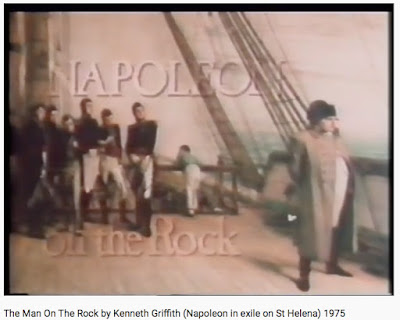
The Man on the Rock - Kenneth Griffith (1975)


On our recent visit to St Helena we were privileged to be able to watch this powerful performance by Kenneth Griffith on a large screen. It first appeared in 1975, but has long since been forgotten, and it was difficult to find a copy. We were surprised and pleased to find that it is now available on youtube

Click Here To View .

It was filmed on St Helena and one of my friends on the island remembers Griffith coming to the local amateur dramatic group on a number of occasions during his stay.

Griffith plays Napoleon's gaoler Sir Hudson Lowe as well as Napoleon, which is a remarkable achievement in itself. His portrayal of Lowe is at times rather amusing and after half a century and much scholarly activity still seems an accurate one.

Any recent visitor to St Helena will note how the presentation of the French Properties has greatly changed since the film was made.

It is very highly recommended viewing for anyone interested in the captivity of Napoleon.

Tuesday, 2 February 2016

Napoleon at St Helena: Exhibition in Paris


Exhibition at Musée de l'Armée - Invalides

During my last visit to St. Helena in early 2013 much of the Longwood furniture, including the famous bath and billiard table, was crated and despatched to France, for restoration and then exhibition.

The dates of that exhibition have now been confirmed. It opens in early April at the Musée de l'Armée and runs until July. It will provide an opportunity for Parisians and those from further afield to learn a little more about Napoleon's captivity on St Helena.

I have already made my plans to visit, and look forward to seeing the restored furniture in a totally different environment. Coinciding as it does with the opening of the airport (fingers crossed!), the exhibition will hopefully provide a boost to tourism on St. Helena.

On that note I have also learned that the island council has thankfully turned down the proposal to locate a water tank at the gates of Longwood house. A very sensible decision.

Friday, 20 September 2013

Images of Napoleon on St Helena 1818-1821

NAPOLEON I two months before his death, sketched from the life by the English Naval Captain Maryat [sic]

I have in the past posted some images of Napoleon made after his death. I thought it might be interesting to display these lesser known images of him made made by Englishmen on the island in the later years of his captivity.

Napoleon 1820, from drawing made by Captain Henry Duncan Dodgin of 66th Regiment

I have serious doubts about the very unflattering portrait with the German inscription, allegedly painted by Captain Marryat in 1821. Napoleon ventured out so little in the weeks before his death that it would have been near impossible to have made an accurate sketch of him, and I would be surprised if he ever willingly posed for one of his captors.

Napoleon 1818, painting by Basil Jackson

I also wonder if there was not a certain amount of conscious or unconscious copying by the various artists.

Friday, 13 September 2013

In the Steps of Napoleon: The Fishers Valley

The Honorary French Consul and an abanoned Ford above the Fishers Valley

There is litle to bring most tourists to the Fishers Valley. We had not ventured here on our first visit to St Helena, but this time Michel Martineau, sometimes referred to, not entirely with his approval, as Napoleon's representative on earth, promised to show us the way.

Close to Longwood, and within the perimeter of the area in which Napoleon was allowed to ride unescorted, at the bottom of Fishers Valley is a narrow stretch of fertile land in which a number of poor farmers once lived and tried to scratch out a living.

There are still signs of cultivation in the valley, but not of human habitation.

Down here Napoleon and his companions could ride among the inhabitants, but were forbidden to comunicate with them.

Little now remains of the small farms that once were here.

Their rude architecture provides a great contrast with the country houses built at the same time by St Helena's elite.

The Nymph of the Valley

Riding in this rather depressing valley in January 1816 Napoleon and Las Cases came across Mary Ann Robinson, still only 16, maybe not as beautiful as the Longwood entourage, short of female company, found her.

Napoleon gave her some gold coins, named her "the Nymph of Las Cases", and the valley where she lived with her parents and sister as "the valley of silence".

Soon though for the Longword entourage, and for the whole island, she became "the nymph of the valley".

Both Gourgaud and Piontkowski coveted her affections, as did a number of soldiers, but their intentions were not entirely honourable, and she was looking for a more permanent commitment.

This she found in the person of Captain James Ives Edwards, whose ship Dorah arrived at St Helena on 5th July 1817 with the 53rd Regiment. The good Captain asked for her hand on 7th July, they were married on 17th and the nymph departed her valley and St Helena on the 29th.

A Fishers Valley Farm, often held probably mistakenly, to be the home of the "Nymph"

Before leaving, on July 26th, 1817, Mary Ann brought her new husband to say goodbye to Napoleon. According to Napoleon the Captain bore a resemblance to Prince Eugène.

That is about the last that was heard of "the Nymph". Unlike Betsy Balcombe she never tried to profit from her acquaintance with Napoleon. (1)

The husband, Captain John Ives Edwards, who evidently had some sympathy for Napoleon's plight, visited Mme Bertrand a few weeks before Napoleon died.

The Valley has its own beauty, but one can imagine how desolate Napoleon and his party must have found it, particularly amidst the mist and rain which are constant companions in the winter months.

It was ironic to find down here a few clumps of the Australian daisies, the gift of Lady Holland to the inhabitants of Longwood, which have now spread over the island and provide a permanent memorial to Napoleon's captivity.

Because of the construction of the airport it is at present not possible to complete the route Napoleon often took back behind Longwood.

We were also obstructed by a large amount of water, somewhat surprising in view of the shortages and the long period of drought that the island was going through at the time of our visit!

-------------------------------------------------------

1. There is a chapter on Mary Ann Robinson in Chroniques de Sainte-Hélène : Atlantique sud by Michel Martineau, pp 163-168.

Sunday, 11 August 2013

In the Footsteps of Napoleon: The Beauty and the Legend of Mount Pleasant

Mount Pleasant

On our 2008 visit to Sandy Bay we viewed Mount Pleasant from a distance, but this time, with the kind permission of its owners, we were able to walk round the garden,

admire the wonderful views,

and sit on the very same steps that Napoleon used on his last sad outing from Longwood in 1820.(1)

On the steps at Mount Pleasant

We also learned some of Mount Pleasant's secrets.

Napoleon and Mount Pleasant: The Legend

After our visit to Mount Pleasant I was fortunate to meet Bernie Thomas, who was born at Mount Pleasant in February 1936. Bernie's family had lived as slaves/servants on the farm at least since the time of Napoleon. Bernie later accompanied me on a visit to Mount Pleasant and told me the stories about Napoleon that have been passed down through successive generations of his family.

Mr Bernie Thomas seated in "Napoleon's chair"

Historians of the captivity are prepared to concede that Napoleon may have visited Mount Pleasant once before his well documented visit at the end of 1820. But according to the legend passed down in Bernie's family, he actually visited five times, and used to sit in the chair named after him, made out of rocks set in the side of the hill just before the house.

Opposite "Napoleon's chair" are two large Norfolk pines. Until recently there were five: one was planted each time Napoleon visited, or so the legend would have it.

The Two Remaining Pines opposite Napoleon's chair

Close up of one of the pines, showing its wide girth

Moving on towards the house, Bernie explained that in his childhood the lawn was larger than now, and to the right of the house a bush formerly grew. He was told that it had been planted to mark the spot on which Napoleon's picnic table had been set up in 1820.

Bernie pointing out the position of Napoleon's picnic table

Finally, according to the story passed down through Bernie's family, one of his forefathers assisted Napoleon in mounting the steps to go into the house.

Bernie on the steps at Mount Pleasant, where one of his ancestors assisted Napoleon

The absence of folk memory about Napoleon on St Helena has hitherto been an accepted fact. I have always taken it to be a result of the dispersal of the white population from the middle of the nineteenth century. Visitors to the island before then, particularly to Napoleon's tomb, were certainly regaled with stories both apocryphal and true about the dead Emperor.

The slave and free black population, the ancestors of most who now live on the island were, from the very beginning, for security reasons, kept as far as possible from Longwood, and few had any contact with its occupants. So the lack of folk memory about Napoleon is hardly surprising. I would go further and say, from my admittedly limited experience, that apart from ghost stories, St Helena does not have a rich folk memory.

I felt it was important therefore to record these stories. The fact that these memories have been passed down, doubtless embroidered, from generation to generation in one family that did apparently have some contact with Napoleon, is of some significance. It certainly requires us to qualify the conventional view of the indifference of the St Helena population to their most famous inhabitant.

-----------------------------------------------------------------

1. An account of Napoleon's last outing when he breakfasted on the lawn at Mount Pleasant and was entertained by Sir William Doveton, has featured previously in this blog.

Friday, 20 April 2012

New Books on Captivity of Napoleon on St Helena


Two new books about Napoleon's Captivity are shortly to be published.

First to appear will be Albert Benhamou's latest book, InsideLongwood: Barry O'Meara's Clandestine Letters which publishes the letters that Napoleon's doctor, Barry O'Meara, sent from St Helena to his friend at the Admiralty. These were circulated among the Government of the day, and were an added source of tension between O'Meara and Governor Sir Hudson Lowe who knew of the correspondence but was unable to stop it.

This will be the first time these letters have been published. I have had a pre-publication preview and believe that it will provide an important and unique perspective on Napoleon's captivity on St Helena in the years 1815-1818. It may be pre-ordered at Amazon.

Also due for publication in June is a reprint of Betsy Balcombe's famous Recollections of Napoleon on St Helena.

This is being reprinted by Fonthill Media, which has a number of other Napoleonic titles on its list.

Monday, 9 April 2012

Images of Napoleon on his Deathbed


Little known drawing by Lieutenant Guy Rotton of the 20th Foot
Trevor Hearl Collection, Bodleian Library, Oxford


I have been looking at a recent article by Albert Benhamou which discusses various sketches made by some of the many English who came to Longwood to view Napoleon's body after his death. Among them was the above drawing made by Guy Rotton, an officer in the 20th Regiment, which arrived on St Helena in 1819, and replaced the 66th Regiment on Deadwood Plain in February 1820. (1)

Portrait by Joseph William Rubidge (1802-1827)


Rubidge, a portrait painter, happened to be passing through St Helena at the time of Napoleon's death. His work erroneously portrays Napoleon with sideburns, which also appeared on the romantic painting done by Émile Jean-Horace Vernet (1789 1863) in 1825.


Christ like portrait of Napoleon on his death bed by Vernet


Albert speculates that Vernet might have seen a copy of Rubidge's portrait. He was after all the only professional artist to have attended the scene, and a number of copies of Rubidge's work were printed. Vernet is unlikely to have seen the work of any of the amateur artists who attempted to recapture the great man on his death bed.

Whether the sideburns were on the original or not is unknown. It was apparently bought by George Horsley Wood, and later presented by him to Napoleon III. It seems to have disappeared at the end of the Second Empire, perhaps in the burning of the Tuileries during the Paris Commune.

Finally Albert discusses a drawing sometimes attributed to Louis Marchand, faithful valet to the Emperor.


Drawing wrongly attributed to Marchand almost certainly the work of Captain Marryat


Albert suggests that there is no evidence that Marchand himself made any drawing at this time. He concludes, based on its similarity to another of his works, that it was done by Captain Marryat (1792-1848) of the Royal Navy, who conveniently happened to be on the island at the time. (2)


-----------------------------------------------------------------------------------
Notes
1. Little is known about Rotton, other than his marriage in January 1820 to Maria South, youngest daughter of Lt. Colonel Samuel South, commander of the 20th Regiment.
2. Frederick Marryat later became known as a children's author, publishing a number of stores based on his sea career, and "The Children of the New Forest", about a Royalist family who hid in the forest during the years of Parliamentary rule in the seventeenth century.


Tuesday, 10 January 2012

New Longwood House


The new house built for Napoleon at Longwood - a mid nineteenth century view.

Longwood House was always intended to be a temporary residence, and on 17th May 1816 Sir Hudson Lowe told Napoleon that the materials necessary for building a new house had arrived. Napoleon, uwilling to accept his permanent imprisonment on the island, would not discuss it with him.

Sir Hudson Lowe prevaricated as to where it would be built, but eventually, in 1818, began construction on a site next door to Bertrand's cottage. It was pretty well completed by the end of 1820.

The house was pre-fabricated by John Bullock in London. Construction was under the command of Major Emmet. Among those working on the project were Mr Paine, a painter and paper hanger sent out from London, and Mr Darling, who served as undertaker at Napoleon's funeral and also assisted at the exhumation.

Napoleon watched the house being built, and once secretly visited it, but he always maintained that he would never live there. Shortly before his death he strongly objected to the iron railings that were placed around it, which to him had the appearance of a prison. These were removed and later used to fence off his grave.

In the last hours of Napoleon's illness Lowe and his assistant Major Gideon Gorrequer waited there for news.

No trace of the house now remains. It was demolished in 1947 and agricultural buildings now stand on the site.

Longwood House itself came very near to a similar fate around the same time.

For another image see previous blog on sites associated with the captivity of Napoleon.


Monday, 21 November 2011

Faithful Servants of Napoleon: The Archambault Brothers Part 2


Card Steuben, Mort de Napoléon Ier à Sainte-Hélène, le 5 mai 1821
Achille Archambault highlighted

Achille Thomas L'Union Archambault was born at Fontainebleau in 1792. His parents never married and he took his mother's family name. His father was Genevieve Agathe Songeux, a native of Fontainebleau, who appears to have taken little part in the life of Achille or of his younger brother Olivier.

When their mother died in 1799, the Archambault brothers were put in the charge of l'hospice du Mont Pierreux at Fontainebleau where their widowed grandmother was living. Their grandfather had been a postillon, and not surprisingly perhaps they followed in his footsteps. Both brothers were fortunate to find positions in the Imperial stables around 1807, and it was at St Cloud that they learned the trade that was to take them as footmen into the service of the Emperor, and finally into exile on St Helena. Achille was present on Elba and at Waterloo. It is not clear whether his younger brother was also there.

Whilst the younger Archambault was forced to leave St Helena in 1816, Achille stayed until the end. Following this separation the two brothers followed totally different paths, and did not meet again for 40 years.

On St Helena Achille was under employed for much of the time because of the determination of the Emperor not to go outside the small area in which he was allowed without being accompanied by an English officer. Achille, like many of the servants and the English attached to Longwood drank and engaged in rowdy behaviour. In September, 1818, when the Emperor's horses, Dolly and Regent, were racing at Deadwood, a certain half-mad and drunken piqueur of Napoleon, who turned out to be Achille, rode down the course. He was horsewhipped by the steward who did not know that he was one of Napoleon's servants. (1) Napoleon saw the whole incident from his vantage point at Bertrand's cottage, and later reprimanded Achille.

Whilst on St Helena Achille formed a relationship with a black girl, Mary Ann Foss. Napoleon refused permission for him to marry her, and finally, to the surprise of Montholon and others who knew his determination and his fiery temparament, Achille relented, perhaps fearing expulsion from the island, but he continued to cohabit with her.

In 1820 as a result of the decision of the Governor to extend the area in which Napoleon could travel, Achille found his services were frequently required by the Emperor. He also acquired a new horse for Napoleon, "King George", from Lord Somerset. The horse was renamed "Sheikh", after one of Napoleon's old horses used during his military campaigns.

In October 1820, Napoleon made his last outing outside the environs of Longwood, to visit Sir William Doveton at Sandy Bay, and when he was unable to complete the return journey on horseback it was Achille Archambault who was summoned to bring the caleche which transported him from Hutts Gate back to Longwood.

When Napoleon died Achille assisted at the autopsy, and according to Sir Thomas Reade was the only one of Napoleon's followers present who was visibly upset by the occasion. At Napoleon's funeral he walked behind the cortege holding "Sheikh" by the bridle .

Returning to France, he settled in Sannois in the Val d'Oise. In 1822 he married Julienne Clarisse Boursier and they had two daughters, Euphraise Clarisse and Josephine Esther.

After the 1830 Revolution he was helped by General Gourgaud to get a job as an usher at the Tuileries.

In 1840 he accompanied some of his former companions on the expedition back to St Helena to return Napoleon's body to France. On this occasion his old lover Mary Ann Foss, accompanied by her husband, met some of his associates. It is uncertain whether Achille himself met her.

Along with other Longwood servants he received the Legion of Honour in 1851.

He was paid the remainder of Napoleon's legacy by Louis Napoleon in 1855.

He died and was buried at Sannois in 1858, almost two years after meeting his younger brother whom he had not seen since 1816.


I must acknowledge again my debt to Albert Benhamou. Much of the material here has with his permission derived from Les Frères Archambault on his web site.

-----------------------------------------
1. Events of a military life: being recollections after service in the Peninsular war, invasion of France, the East Indies, St. Helena, Canada, and elsewhere, Henry Walter,(1846) pp 26-27.


Thursday, 17 November 2011

Faithful Servants of Napoleon: The Archambault Brothers Part 1


Joseph Olivier Victor Senez Archambault (1796-1874) (1)


Among the party who set out with Napoleon to St Helena were two brothers, Achille Thomas L'Union Archambault and his younger brother (Joseph) Olivier Archambault, both working in the stables under the command of General Gourgaud.

This article tells the story of Olivier Archambault, who spent only a short time in the service of the Emperor Napoleon on St Helena, but under the instructions of the Emperor followed Joseph Bonaparte to America, settled there, prospered, and raised a family.

Gravestone in Pennsylvania


Born Aug 22nd 1796 Died July 3rd 1874


In September 1816 Napoleon was forced to reduce the size of his household at Longwood, and the younger Archambault, the Polish officer, Captain Piontowski, and two servants at Longwood, Jean Giovan-Natale Santini and Theodore Rousseau, were sent off the island, initially as was the custom, to the Cape. Apparently Napoleon wished to avoid splitting up the two brothers, the younger of whom was barely 20, and he suggested that Bertrand's servant Bernard, or his own servant Gentilini should go instead. The Governor refused: Bernard was Flemish and Gentilini Italian, and his orders had been to remove three "French domestics"!

The four of them were meant to spend several months of "quarantine" on the Cape, but Admiral Malcolm, apparently ignorant of Lord Bathurst's instructions, after a few weeks sent them back to Europe via St Helena, where they duly arrived to the consternation of the Governor on 18th December 1816. Every conceivable step was taken to prevent communication with anyone on the island, although the Governor did grudgingly allow Achille to talk to his brother on board the ship, accompanied by the commissioner of police.

Arriving in England in early 1817, Olivier and Rousseau proceeded to New York with letters for Joseph, a plan of attack and a detailed map of St Helena sewn inside Rousseau's jacket. Joseph Bonaparte was preparing an expedition to free Napoleon and to take him to New Orleans where a house, Napoleon House, was readied for him. This plan was of course scrapped, but Napoleon House remains to this day.

On the ship travelling to America he met the English radical William Cobbett, who was leaving the country to avoid imprisonment in the repressive period after Waterloo. Joseph spent a year on Cobbett's Long Island model farm, teaching French to his son and receiving instruction in scientific agriculture.

In 1819 Joseph Archambault married a woman of good family, Susan Sprague (1793-1880), and the couple settled first in Philadelphia and then at Newtown, some 40 kilometres outside Philadelphia where Joseph bought a house and some land. (2)

In 1829 he bought the Brick Hotel in Newtown. He also established a post office and a dentist's practice, in which he worked for some time. Presumably his knowledge of the anatomy of horses provided some kind of foundation for this profession!

In 1837 he settled again in Philadelphia, and in 1840 was named Cavalry Captain for Bucks County.

On 3rd May 1856 he set sail for France to meet his elder brother for the first time since they had said goodbye on board a British naval ship in Jamestown harbour in December 1816. Achille had been given a grant by Napoleon III of the remainder of the money bequeathed to him by Napoleon, and it is possible that he was given a share of this money.

In the American Civil War Joseph became a Major in the US Cavalry, and his sword and a picture of him is in the Mercer Museum.

He died on 3rd July 1874, one of the last survivors of the party who had accompanied Napoleon to St Helena, and living long enough to witness the fall of Napoleon III.

He was outlived by his five children, four of whose names evoke his youth in France: Victor Ebenezer Archambault (1819-1893); Achille Lucien Archambault (1822-1906); Lafayette Archambault( 1824-1888); Napoleon Bonaparte Archambault (1826-1901); Roselma Josephine Archambault (1832-1914).

The most famous and most long lived of his descendants was his grandaughter Anna Margaretta Archambault (1856-1956), a distinguished portrait artist, miniaturist and author. As Albert Benhamou comments, she lived through the American Civil War, the Franco Prussian War, the First and Second World Wars, and could claim to have known someone who had accompanied Napoleon to St Helena!

My thanks to Albert Benhamou for all his research and his generosity in encouraging me to draw on Les Frères Archambault on his web site, and to Joseph OVS Archambault for contacting us and providing information on Joseph Archambault's descendants which inspired the piece.


-----------------------------------------------------------
(1) Born at Fontainebleau he was given the forenames Olivier Agricola. It is possible that the name Joseph was adopted much later on his arrival in America to meet Joseph Bonaparte. Senez was his natural father's name and appears only to have been used when he arrived in America. When he substituted Victor for Agricola is unknown.
(2) Joseph Bonaparte had already established himself in the Philadelphia area, where he built a substantial house at Point Breeze, which was burned down in 1820, allegedly by a Russian lady. He built another house on the same site, and lived there until his return to Europe in 1839.

St Helena Connection: Interview with Michel Martineau


The latest edition of The St Helena Connection, the news magazine of the Society of Friends of St Helena has just been sent to members. It is always interesting, as is The Wirebird , the Society's Magazine, back copies of which are available online to members of the society.

The current edition of The Connection features an interview by Irene Delage with Michel Dancoisne Martineau, since 1987 Honorary French Consul and curator of the French properties on St Helena. The article is reproduced from the website of the Fondation Napoleon.


The interview focuses on the background to Michel's book, Chroniques de Sainte-Hélène Atlantique Sud In the interview he discusses one of the important themes of the book, the often overlooked tension between Crown and East India Company, which formerly "had the power of life and death over everyone on the island", and "was severely undermined the moment Napoleon arrived on St Helena."

The most surprising examples of this rivalry can be found in discussions relating to farming and religious matters. Hudson Lowe, the governor of the island, was the first victim of this conflict, caught between the interests of the British crown (which he served) and those of the East India Company (whose representatives held a monopoly over civil administration and religious posts). The issues surrounding supplying the island, the imposed curfew, restricions on the population's movements, and the added drain on resources did little to simplify matters.

So overlaying the conflicts between Plantation House and Longwood House, and between Army and Navy, not to mention the strange position of the representatives of the Governments of France, Austria and Russia, there was an uneasy relationship between the governor and the small number of leading families and the company appointees, notably Rev. Boys, who had governed the island in the East India Company era. Their world had been overturned, and things for them were never to be quite the same again.

Tuesday, 8 November 2011

Napoleon's Last Days: Building Castles in Spain


Photo by Esther Gibbons


By the beginning of 1821 Napoleon was convinced that he would not last out the year, and he quoted Voltaire's Lusignan, Mais à revoir Paris je ne puis plus prétendre (1)

For a time Montholon in particular kept up his spirits by passing on, and perhaps embellishing, rumours that Napoleon would soon be removed from St Helena. The backdrop to this was the crisis in England between George IV and his estranged wife, Caroline of Brunswick, a symbol of popular opposition to the Government of Lord Liverpool towards the end of 1820. Clearly the prospect of the return of at least some Whigs into Government was a hot topic at Longwood and Plantation House and probably elsewhere on the island, although such discussions were informed by news that was at best a couple of months out of date.

In January 1821 the comments of the French Commissioner, Montchenu, were reported by Count Montholon, and together with Napoleon's reaction were noted by Bertrand.
He says there is talk of making Belle Isle into a residence for the Emperor. That would mean taking a great risk. The English could no longer have the custody of the Emperor.

On the subject of Belle Isle, the Emperor believes that the intention of the powers that be would be to keep him there under the same conditions as at St Helena, with a governor, a garrison and a cruiser, just as we have here. But the Emperor will never consent to that. He would be at the mercy of the Congress of Aix-la-Chapelle which would be able to have him assassinated there. He would never agree to it.

Or perhaps they want to give him Belle Isle as a place of refuge, with a batallion of his own as at Elba. That would be a different matter, but it would be unwise from the point of view of the Bourbons, on account of the present state of unrest in France.

This account concluded with the somewhat risible claim by Montchenu that the King of France had never approved of the Emperor being taken to St. Helena, that personally he liked the Emperor very much indeed .. (2)

On February 19th further discussion was reported by Bertrand.
It is rumoured that the Emperor may be sent to England. He thinks that this seems to indicate that the English do not wish to be rid of him.

Napoleon seemed encouraged:
They could keep me on a very large estate. .. True I could then escape more easily than from here. Yet it is a much more feasible idea than Belle Isle. A safe place could not be found for me so close to France, not one where I could be interned and yet enjoy a certain amount of freedom, as I do here .. (3)

On Feb 28 the Governor sent over some newspapers which reported that the unpopular Royal divorce bill had been withdrawn by the Liverpool Government, a loss of face which seemed to presage some change in the composition of the Government.
Our hopes and conjectures on the possibility of a new government wore us out. Our hopes that Lord Grenville will be in the new Cabinet and that we shall be moved from here. (4)

By March 6th though Napoleon was sad and has lost all hope of any change in the English Government. (5) But three days later the comments of the rather foxy Major Gorrequer as conveyed by Count Montholon seemingly had raised his spirits.
Lord Holland has been spoken of as a possible Prime Minister. The Governor will then pay him a great tribute - wise man. The Governor is a schemer. The English do not want to keep the Emperor any longer, and yet they do not want to hand him over to the other powers. The Emperor may therefore entertain hopes of going to America. (6)

So the next day, March 10th He felt much better and toyed with the idea of doing some riding. He hopes soon to leave St Helena.

He was prepared to go to England, Austria, America, anywhere but the hated St Helena:
The Emperor believes that the English will not want to be rid of him. But that they would keep him in England on some large private estate, and that they would accept his parole not to leave the county in which he was living without the Government's permission. Otherwise he would be quite free. .. He cannot see what the English have to fear.

If the Austrian Emperor were to write and offer him asylum in his States, and if the Empress would also write to him, then he would go to Trieste with no mistrust, so as to be with his wife and son.

If I had the choice I would go to America. .. First I would restore my health - then I would spend six months travelling about the country. .. Among other places I would pay a visit to Louisiana; after all it was I who gave it to the Americans.
(7)

Bertrand noted that Napoleon worked the entire day. He was pleased and had hopes of finally being able to leave this miserable island. He was also reading books about America and speculating about visiting his brother's estate at Trenton.

Three days later, on March 13th their bubble was burst. Another ship arrived from England, and the Governor sent over some newspapers for the period November- December 1820:
No change of Government. The French elections were not liberal. This news was a great disappointment to everyone, above all to the Emperor, who has flattered himself on better news.

"We have been building castles in Spain," he commented.
(8)

Over a month later John Ives Edwards, sea captain and husband of Mary Anne Robinson (the "Nymph"), and "much attached to the Emperor", called on Mme Bertrand. His conversation, a rehash seemingly of old news, was reported to Napoleon
He said that the English people had no wish to keep Napoleon at St. Helena, and they felt that the ignoble way in which the Emperor was being treated was a slur on them.

It cannot be long before he will leave here, perhaps in less than three months. Probably Admiral Lambert will accompany him back. .. It is public opinion that is forcing Lord Holland into the Government, not any political party but unanimous public opinion.

Napoleon was not impressed by this, "it is too late now" he said. (9)

In less than three weeks he was dead.

It was to be another nine years before the Whigs returned to Government.

-------------------------------------------------------
1. Napoleon at St Helena. Memoirs of General Bertrand Grand Marshall of the Palace January to May 1821 (Cassell & Company 1953) p.65
2. Bertrand p. 21
3. Bertrand p. 71
4. Bertrand pp 96-7 The withdrawal of the unpopular bill had of course taken place some two months earlier, and it had in fact helped to dissipate the extra parliamentary opposition. Nobody on St Helena could have known this.
5 Bertrand p. 116
6. Bertrand p. 120
7. Bertrand pp 120-121
8. Bertrand pp 121
9. Bertrand p. 172

Monday, 20 June 2011

The 20th Foot and a Gift from Napoleon - The Fusilier Museum Bury


The Fusilier Museum in Bury has a small but priceless collection related to the last days of Napoleon. The centre piece is the three volumes of Coxe's Life of Marlborough, the gift of Napoleon to the 20th Regiment, which caused so much consternation to the Governor, Sir Hudson Lowe, and so much trouble to Captain Lutyens, the orderly officer at Longwood.


There are also a number of other items on view, including the medals of Dr Arnott, the last British doctor to attend Napoleon on St Helena, and the tunic he wore when attending him.


This tunic, and the picture of Arnott (below) were apparently rescued from the ruins of the home of a descendant of the Arnott family after the Lockerbie bombing in 1988, and but for that atrocity these items might never have been recovered.


Arnott, Archibald, M.D. (1771-1855). Surgeon to the 20th Foot Regiment, he was called to attend Napoleon on April 1st, 1821 and continued to attend him until his death on May 5th.

Whatever his limitations as a doctor, Arnott got on well with Napoleon.

During one of their conversations Napoleon praised the men of the 20th Foot and said that he would make them a gift of Coxe's Life of Marlborough.

The three volumes of this book were subsequently put in Captain Lutyens' room without explanation, presumably by St Denis.

On our visit we were privileged to be able to examine the famous books, and to photograph the three words, "L' Empereur Napoleon", which were like a red rag to a bull to Hudson Lowe.

Volume Two of Coxe's Life of Marlborough with three fatal words inscribed at the top. (Click to enlarge)


The inscription, almost certainly made by St Denis, who acted as Librarian at Longwood.


The books were returned to Longwood, although later the 20th Regiment was allowed to receive them, and for some time thereafter they were proudly kept in the officers' mess.

Happily Napoleon, in the last stages of his final illness, was not informed of what he would surely have regarded as one of the most hurtful of many insults. Even William Forsyth, Hudson Lowe's most faithful defender, conceded that "Napoleon's kindly meant present might, under the circumstances have been accepted. .. nor was there much likelihood of a British regiment being seduced from its allegiance by adding to its library a few books, the gift of Napoleon."

Blamed for his failue to return Napoleon's gift, Captain Lutyens was removed from his post. A decent man whose loyalty was unimpeachable, the incident was for him a disaster which must have overshadowed the rest of his short life.

Lutyens, Captain Engelbert (1784-1830). Orderly Officer at Longwood (1820-1821).

Member of a family which had come to England from Hamburg in 1745, and which was to produce one of Britain's best known architects.

Suspected by Hudson Lowe and Thomas Reade of being too friendly with the French at Longwood, honestly reporting the deterioration of Napoleon's health from November 1820, and very uncomfortable about being required to spy on Napoleon during his last illness, Lutyens had previously asked to be removed from Longwood at the end of December 1820.


For Captain Crokat, who replaced Lutyens at Longwood and subsequently had a very successful career and lived to the age of 90, it proved a very lucky break.

Crokat, William (1789-1879).

Having replaced Lutyens as orderly officer at Longwood he was given the honour of taking the news of Napoleon's death to London, for which he received the sum of £500, a large amount in those days.

He was also promoted to Major, ahead of Lutyens.

Lutyens, after a lengthy process was successful in getting his own promotion to Major backdated to 1821, as clear a sign as possible that the Army recognised that he had been wrongly treated.


Crokat whose bust is in the Fusilier Museum, ultimately rose to the rank of General,


and was one of the very few people who served on St Helena during Napoleon's captivity who can be said to have had great success afterwards.

Finally a note about the disputed books. Contrary to what has been written in a number of published accounts, these were the gift not of Captain Robert Cavendish Spencer, who happened to be on St Helena at the end of 1820, but of Lord Robert Spencer, the youngest son of the 3rd Duke of Marlborough. The books apparently had been sent via Lady Holland, at the centre of that group of Whigs who were opposed to the Government's treatment of Napoleon, and who sent many books to St Helena for Napoleon.

Allegedly Count Bertrand and/or his wife provided a French translation of Marlborough's biography for Napoleon. This translation, if it existed, has as far as I am aware never been found.

My thanks to Paul Dalton of the Fusilier Museum, and to Albert Benhamou, without whose help this blog would not have been possible.