Friday, 20 February 2026

Journey's End: - Le dernier Napoléon


"This last Napoleon is multifaceted. He is the one we like to imagine".

When I first heard of the title I thought immediately of the oft-quoted monologue in As You Like it:

 	All the world’s a stage,
	And all the men and women merely players;
	They have their exits and their entrances;
	And one man in his time plays many parts,

Napoleon certainly played many parts in his life. This is an account of his final role, proud captive of the mighty British state, and performing on his final stage, Longwood House, the decrepit rat infested house which to the very end he resisted leaving, aptly referred to as the Wuthering Heights of the Tropics by Jean Paul Kauffmann (1).

Longwood House from Napoleon's gardens recreated by the author

On this stage he was accompanied by a motley crew, jealous of each other, threatening to leave, and unlike him free to do so, trying to to meet his needs, each with their own interests, noting down for posterity much of what he did and said, but failing to penetrate the front he presented to them and to the world, when he had given up all hope of being allowed to return to Europe,

Michel Dancoisne Martineau is uniquely placed to write the history of Napoleon's final years. For fifteen years he lived in Longwood house and with that experience and an artist's eye he is able to provide the reader with an almost microscopic description of Napoleon's physical environment. A trained horticulturalist he was able to recreate the gardens that were so important in the final agonising phase of Napoleon's life, and their construction is uniquely covered in this book.(2)

Before writing he read every book that Napoleon read in his final two years, in identical editions. Finally, in addition to all the archival research and the renovation at Longwood and the other French properties on St Helena, this book is the product of almost a lifetime's reflection on the island.

The gardens from Lonwood House

It is a deeply human story, a post mortem on Napoleon's psyche, through the various stages of his mental adjustment to permanent exile. Without family, lacking any meaningful occupation or intellectual stimulus, in his eyes everything he tried ended in failure.

His attempts to influence opinion in Europe were totally ignored by the major powers at the Congress of Aix La Chapelle.

His efforts to win over a number of the most cultivated British officials he met on the island were ultimately fruitless, they all left.

His attempt at his memoirs left no significant writings for posterity. He was unable to compete with European authors who were publishing far better researched accounts of his years in power. As the author bleakly puts it, Napoleon could no longer tell the story of Napoleon.

So Napoleon read a great deal and ultimately, in search of a meaningful existence, followed the advice given in Candide by Voltaire: Il faut cultiver notre jardin. With the aid of reluctant French compatriots, English soldiers and Chinese servants he created a remarkable garden, reflecting his long standing love of shade and water, so there were fish ponds and water tanks, a central stream, a grotto and an enclosed walkway.

Unfortunately the fish started to die, and Napoleon lamented

You can see that there is a curse on me. Everything I love, everything that is attached to me, is immediately struck down.

But he was never one to give up. He moved the surviving fish to uncontaminated water in a wooden tank, and continued to visit them as long as his failing health permitted.

The author builds up a powerful picture of the torment Napoleon must have felt as his hopes of ever again being free were dashed. To avoid over-use of the word Napoleon he effectively employs a multiplicity of designations:

the vanquished of St Helena, the unknown of St Helena, the hero-prisoner, the prisoner of Europe, the prisoner of nations, the imperial prisoner, the prisoner of the South Atlantic, the banished of nations, the disrupter of nations, the banished man of Europe, the modern conqueror, the man of the century

But Napoleon was not only dealing with adversity, during his exile he observed and encouraged the development of an image of himself as the persecuted "champion of Jacobinism". He had been sent to this remote, almost unknown island in the hope that he would be totally forgotten and that the ideas of the French Revolution that he had come to embody should be buried with him. In fact, although a mere dot on the map and no more than a footnote in global history, St Helena actually created the Napoleonic legend. As I may have said before, without St Helena Napoleon would not have been Napoleon.

Early in the book the author refers to the building of the legend amongst the liberal intelligentsia in Europe, particularly in Britain.

St Helena, tiny rock in the middle of an immense ocean, a reef conducive to the imagination, could only enhance the poetic twist - to use Germaine de Staël's phrase - of Napoleon's existence. For if one could without too much effort physically confine a man, the great adventure full of action and twists and turns that was his life could not remain inert in the popular imagination. Inevitably, it would attract people as a magnet attracts steel filings.

Vernet, The Death of Napoleon, 1826

This theme is discussed at length in the final chapter entitled Napoleon: the enchained Promethian which begins with a quote from Anthony Burgess What Myth? What hero? Aaaaah - Prometheus, and delves into the creation of the legend which took both Promethean and Christian martyrdom symbols to describe Napoleon's fate at the hands of Britain. (3) The author, who came to St Helena via his interest in Lord Byron, one of the key though ambiguous figures in the building of that legend, is dismissive of these interpretations, although very aware of their power in the past. (4)

The image of the last Napoleon is what each one wants or doesn't want to see... St Helena has generated around the representation of the banished man of Europe a fog as dense as that which most of the time covers the Longwood plateau. A drizzle capable of misleading minds.

The author himself is neither pro- nor anti-Napoleon, a position which many scholars fail to take. Napoleon was undoubtedly one of the most remarkable figures to stride on the world stage in the past 1000 years, but although he created much that lasted, he was out of time, the last of the Enlightened despots perhaps. The author sums it up perfectly

Napoleon, the Romantic figure of Promethean and Christian [mythology], in turn insurgent and victim, guilty and innocent, reprobate and redeemer, lived at the crossroads between the Enlightenment and the industrial revolution.

His ambitions for France were not dashed on the playing fields of Eton, but in the factories of Manchester and other industrial towns which were transforming the world and which gave the UK the economic strength to subsidise the allies who largely fought the long wars against Napoleon on its behalf. Paradoxically the liberal ideas, of which Napoleon at the last affected to be the champion, found their strength in those same industrial cities, and in those same cities Napoleon in his final stage found much support.

A Personal Postscript

In my first ever post on this blog I singled out Jean Paul Kauffmann as the only author who had even tried to explore what was going on in Napoleon's mind as he tried to come to terms with his fate, although The Dark Room at Longwood based on a very short visit to the island, could only scratch the surface.

After four visits to the island, and nearing what must surely be the end of this personal journey, it is very pleasing that I am now able to review the book I was looking for over eighteen years ago. It also seems appropriate that its author is none other than the man we met on our very first day on the fondly remembered RMS St Helena, without whom this blog would never have begun.

My only regret is that there will probably be no English edition of Le dernier Napoléon, but the author is in the process of producing Vols 5 and 6 of the bilingual, illustrated Collectors Series which will fully cover Napoleon's final years. These will be available at Longwood House, which I know is a long way to go to buy a couple of books, but I imagine it will be possible to get them mailed overseas.


---------------------------------------------------------------------- 1.Jean Paul Kauffmann The Dark Room at Longwood (London 1999)
2. Kauffmann in his visit to Longwood some thirty years ago produced a perceptive portrait of the author in his youth and commented, “in the case of the present consul the gardens are his life’s work".
3. Anthony Burgess Napoleon Symphony (London 1974)
4. See review of I am the Keeper of the Empty Tomb.

Wednesday, 19 February 2025

St Helena Airport Revisited

Plane landing alongside a problematic rock

It is almost eight years since I last blogged about the airport. Since then it has been operational, but a few fairly major problems remain, COVID has intervened, and the expected or more accurately, hoped for benefits have not materialised.

Most Saints I speak to - I am currently visiting the island for the fourth time - are very critical of the decision to build the airport and nostalgic about the RMS St Helena, which used to be the only link to the island from the outside world. The cost of water, electricity, food and basic essentials has rocketed. Real wages have decreased. The population decrease has continued and the remaining population is rapidly ageing. For those who can afford it the big positive change has been a reliable internet, much cheaper than on our last visit three years ago, and streaming has put the two shops selling DVD's out of business, but it is still about twice the cost in the UK where wages are much higher.


Arriving passengers making their way into the terminal building

A recent UK Government Audit report has spelled out in grisly detail the failure of the airport to do what it was intended to do, i.e. make St Helena self sustaining so that it no longer required large subsidy from the UK.


Firstly commercial viability of the airport is limited by the island’s remoteness, the short runway length and local wind conditions. Extending the runway or removing a hill that exacerbates wind conditions are not considered cost effective

As a result of wind and visibility issues 11% of flights between 2017 and 2024 were delayed or cancelled. In the past two years this has increased to around 25%

The UK Government subsidy for the airport is now around £4 million a year.


The Airport: External View

The main aim of the airport was to increase tourist numbers. These were expected to reach 29,000 after 25 years.In 2023, 2,112 tourists arrived, around a quarter of the approximately 8,000 projected for 2023 in the airport business case.

FCDO now acknowledges that the numbers given in the business case were over-optimistic.

Financial aid provided by FCDO has increased from £16.2 million in 2010-11 to £33.0 million in 2023-24, an increase of 104% in cash terms, or 46% in real terms. Not bad for a UK Government implementing a policy of austerity.

In conclusion the airport has facilitated improved access to healthcare for residents, and an improvement in the quality of life for many, but the hoped for wider economic benefits - increased employment prospects, higher working incomes, more private investment, increased Government revenue to finance public services, a reversal in the decline of the population - haven't materialised.

The report also mentions the dreadful waste of money on the bulk fuel project which was covered here a few years back. £78 million has been spent, the original budget was £31 million, it is now 9 years overdue, and it will need further expenditure to get it up and running in the next three years. Happily all the redundant vehicles shown in my original post are no longer present in Ruperts Valley. Hopefully they have been sensibly disposed of.

In September there will after five years of the new system of Ministerial Government be a General Election. It will be interesting to see who stands and who gets elected and forms the new Government. Big challenges remain.

Friday, 28 June 2024

Napoleon Symphony: "Can Burgess write on Napoleon? Of Corsican." (1)


Burgess's Novel published in 1974, based on the script he wrote for Kubrick

Last year's Ridley Scott film on Napoleon inevitably triggered memories of Kubrick's ill-fated epic, abandoned half a century earlier. The film's reported comedic traits and preoccupation with Napoleon's sex life was a feature of Anthony Burgess's script which following Kubric's rejection metamorphosed into Burgess's much under-rated, comic but unfunny novel.

The inside of the dust cover of Napoleon Symphony describes Napoleon as

inspired general, starry eyed lover, laughable cuckold, evangelising republican, great emperor, bloody tyrant, wretched invalid exile, mythic hero.

Anthony Burgess 1917-1993

Several years ago I came across a file in the Anthony Burgess Centre in Manchester containing a large number of reviews of the novel, including one from Playboy which described it as "his best novel yet", a view endorsed by Robert K. Morris in the Nation (2).

The novel was written in the early years of UK membership of what was then known as the "Common Market", and one reviewer who took this theme was Ronald Blythe, self taught Suffolk writer, author of Akenfield and collaborator with Benjamin Britten and E.M. Forster. Blythe saw the book as profoundly anti-Napoleon and anti Common Market, which views he endorsed:

What Wellington (and de Gaulle) prevented, Heath arranged.

In those days of course the main opposition to UK membership of the European Union came from the Left, which is why the then Labour Prime Minister, Harold Wilson, called a referendum to try to keep the party together, and Blythe was a life-long Labour voter.

One American reviewer wrote on the same theme:

was a "humbled" Britain's entry into Europe's Common Market a belated fulfillment of Napoleon's long-ago war aims? Such a possibility is the final irony in Anthony Burgess's latest extravaganza. (3)

Time Magazine picked up Burgess's pessimism about England and vision of the Anglosphere, including the United States, all united under a constitutional monerchy.

It may sound positively Napoleonic, but it has vision, the vision of a bold artist who has yet to meet his Waterloo.

The novelist Kay Dick clearly did not care for Burgess, whom she rather snobbishly described as "that proverbial bright grammar school sixth former .. yet never quite beyond that sixth form humour." He was "the best barker in the English literary scene", and "a wizard with words, knows them all, uses them as often as he can" and "like his hero, Napoleon, he does not care for women to think." (4)

A number of other reviewers picked up on Burgess's treatment of Napoleon's sexuality and his relations with women. For one American writer the book was "a randy tomcat's view of the Corsican Ogre" and another saw Burgess's Napoleon as "entirely baffled by women" (5) One reviewer saw

a bad lover, as quick in sex as he is in battle..(6)
and another concluded:
Burgess has given us a Napoleon we've never known before. Invincible, crusading, charming, humble, to be sure. Also gross, profane, plagued with heartburn, flatulence, bad breath.. premature ejaculation and, obviously, self-doubt. (7)

Many reviewers made much of Burgess's Joycean love of language and music, his rather self-indulgent cleverness, and his encyclopedic knowledge and cerebrality. As for the portrait of Napoleon, a number of reviewers saw that beyond the earthy, priapic conqueror Burgess was portraying a more complex figure, the rational, Enlightenment ruler who was ultimately defeated by the English who failed to see the light, and by Slavic and German mysticism and nascent German nationalism.

Even his last ingenious construct, the great garden on Saint Helena, is uprooted by a nature drawn like the Greek fate to opposing his grandiose schemes. (8)

Victoria Glendinning's summary of Burgess's Napoleon seems very apt

.. a violent amalgam of intellect and physicality, a 'machine on top of an animal.' The machine part of him juggles with states, statesmen, school textbooks, regiments, rulers, sisters-in-law and the map of Europe. Under the brain machine his body throbs and aches. He lusts lyrically after his whorish Josephine, who dislikes his bad breath and his perfunctory performances.(9)"

Finally a reminder that the book itself was ostensibly based on Beethoven's Eroica Symphony. Its four movements were set in Egypt and Italy, Paris, Moscow and St Helena. For some reviewers it was more noise than symphony, although at least one felt that Burgess like Napoleon and Beethoven had proved that he too was a man of vision, and the Financial Times review concluded that the novel would be relished by admirers of all three! (10)

For a recent review see The Great Napoleonic Novel: "It's a sin to want to die for a nation."
-------------------------------------------------------------
1. Ed Powers writing in Cleveland Press July 26th 1974.
2. The Nation , Aug 3rd 1974.
3. Roderick Nordell Christian Science Monitor May 29th 1974
4.The Scotsman 12 October 1974.
5. Charles A. Brady, Buffalo Evening News June 29th 1974; Martin Washburn, Village Voice July 4th 1974.
6. Newsweek May 27th 1974.
7. Rod Cockshutt, News and Observer North Carolina, June 16th 1974.
8. Mark Mirsky Washington Post May 26th 1974
9. New Statesman 27th September, 1974.
10. John D. Gates. No other identification. Isobel Murray Financial Times 26th September 1974

Saturday, 6 January 2024

Michael Broers on the Ridley Scott film


Having read so many bad reviews I decided not to bother with Ridley Scott's film, but I may be more interested in the four hour directors cut not yet released.

The film apparently focused very much on war and sex, or more particularly on Napoleon's relationship with Josephine. Phoenix is older than Napoleon was at the end of his career, and Josephine, in the film played by Vanessa Kirby, is portrayed as younger than Napoleon when in fact the reverse was the case.

Michael Briers who ironically was involved in the preparation for the film, indicates in a perceptive article that there was so much more to Napoleon than is revealed by the film.


Michael Broers Napoleon: The Decline and Fall of an Empire: 1811-1821 (Pegasus 2022)

Broers is for me the best of the historians of the Napoleonic period, and this interview about his latest book, Napoleon: The Decline and Fall of an Empire: 1811-1821 is also very much worth listening to. Broers offers an interesting perspective on Napoleon's relationship with Josephine, indicating that her aristocratic background was important to a young man who grew up in the ancien regime feeling socially very insecure.

Broers concludes that Waterloo was more important for the reputation and career of Wellington than it was for Napoleon. The 100 Days was a gamble with the odds stacked heavily against him. Even had he won that battle, the strength of the armies allied against him made his ultimate defeat almost inevitable. On Elba he very much feared that the only one of his enemies that would treat him fairly was Alexander with whom her personally got on well. So with very real fears that he might well end up on St Helena or worse, the decision to return to France was the last throw of the dice.

Elsewhere on my blog I have written about Waterloo and its importance for British nationalist mythology and also on the factors that seem to have made Napoleon decide to leave Elba.

Wednesday, 7 June 2023

Kensal Green Cemetery, St Helena and Napoleon


Kensal Green Cemetery, founded in 1833, is the oldest and apparently the most prestigious private cemetery in Britain. The Friends of Kensal Green Cemetery have just released an article by Henry Vivian-Neal about its Napoleonic and St Helena connections.

Tomb of Lt. Col. Gideon Gorrequer, 1780 – 1841

Here are to be found the remains of some of those who served under Hudson Lowe in guarding Napoleon on St Helena. Most well known is Colonel Gideon Gorrequer, whose diary revealed a deeply unsympathetic view of Sir Hudson and his wife. Less well known are General Wynyard, Lowe's military secretary, Alexander Baxter M.D., the doctor whose services Napoleon declined, and Lt Colonel John Ward who served with the 66th Regiment of Foot, made some sketches of Napoleon and assisted with the death mask.

Ward was also present at the exhumation in 1840, as was another inhabitant of the cemetery the Comte de Jarnac, a member of the expedition that returned Napoleon's body to France, who later became French ambassador to the UK.

The man who escorted Napoleon to St Helena in 1815, Rear Admiral Sir George Cockburn, is also buried in the cemetery, as is the Lt Governor, General Skelton, who was on the island when Cockburn and Napoleon arrived. As the author notes, Longwood House was Skelton's summer residence, he and his wife were among the few senior British officials who got on well with Napoleon and frequently visited him.

Perhaps most interesting of all to followers of this blog is Lucia Abell, better known as Betsy Balcombe, whose story has been told and probably embroidered many times.

The most famous person mentioned, albeit with rather tenuous St Helena connections is the writer William Thackeray. Thackeray claimed as a child to have been taken to view Napoleon on St Helena. Although it is not mentioned by the author, Thackeray also attended Napoleon's second funeral about which he wrote a rather irreverent article.

Tomb of Prince Augustus Frederick, Duke of Sussex 1773-1843

The Cemetery also has a few royal graves. The first to be buried was the Duke of Sussex, who strongly associated himself with Whig criticisms of the Government's treatment of Napoleon, and later gave Queen Victoria a book about Napoleon to give her a more favourable view of his achievements.

This is an very well researched piece of work. It is only 30 pages long but includes a very informative history of the cemetery, the background to Napoleon's imprisonment, portraits of the subjects discussed, a map identifying the location of each of their graves in the cemetery and an incredibly detailed index. There are a few very minor errors in it, for example Grand Marshall Bertand only lived at Hutts Gate in the early part of the captivity. He and his family soon moved in to a cottage specially built for them at Longwood, which still stands to this day. Like others the author says that the decision to send Napoleon to St Helena was taken while the Bellerophon waited in English waters, but by the time the Bellerophon arrived in Torbay the decision to send Napoleon to St Helena and to appoint Hudson Lowe as Governor had been made although not publicly announced.

The friends of the cemetery are in September 2023 organising a guided, costumed walk, "Napoleonic Stories at Kensal Green Cemetery."

Monday, 30 January 2023

The Bulk Fuel Installation & "The Saint"

"The Saint" 12 January 2022

I rarely post about modern St Helena, but a recent edition of a new publication, The Saint reminded me of a story I came across when I visited a year ago.

To put it simply, some £80 million of British taxpayers money was spent on a bulk fuel installation in Upper Ruperts and a new gantry in Ruperts Bay, neither of which will probably ever be used.

The new fuel tanks

The airport was a DFID project, and the planning and management was ultimately in Whitehall hands, although "the Saint" seeks to put at least some of the blame on local officials.

The new fuel gantry

Also Ruperts is/was littered with vehicles used in the airport project now slowly rusting away.

Abandoned vehicles in Upper Ruperts

The airport contractors have apparently gone bankrupt, and nobody seems quite sure who the vehicles belong to. This state of affairs should not I think be laid at the door of the St Helena Government, and certainly not the current one which has only been in office for just over a year.

More vehicles
Close up of the fuel tanks
The Fuel Gantry now overshadowing Ruperts Bay

Friday, 25 November 2022

Napoleon chez the Balcombes- A Review


Volume 3 of Michel Dancoisne-Martineau's series, Napoleon and St Helena, the end of an emperor.

This volume provides a very comprehensive account of Napoleon's debarquement from the "Northumberland", his single night in Jamestown at Porteous House, his stay at the Briars and of the people he met during his short time there.

The main character was William Balcombe, "a pathological liar, happy to let people on the island believe he was of royal descent, who because of friends in high places got the apparentlyly lucrative job of procuring supplies for the French and for a time was the host to Napoleon and some of his entourage at the Briars.

Amongst the many unsavoury things we learn about Balcombe is that he continued to import slaves to St Helena after it was illegal, and when he left in 1818 his "herd"" of blacks, as it was called, consisted of twenty males, nine under sixteen, and ten women, four under the age of thirteen.(1) There is much information here also about the whole family after their time on St Helena, including the story of Betsy and her short, disastrous marriage to Edward Abell. Here too is a full account of the life of the slave Toby whom Napoleon befriended and tried to free. A year or so after Napoleon's death Toby was robbed of what was left of the significant amount of money that Napoleon had given him. Fellow slave, Sam, was convicted of the robbery and duly executed in August 1823.

The biggest surprise of this volume was the background about Napoleon's decision to stay at the Briars. The usual version is that on his way back from Longwood to Jamestown Napoleon spotted the heart shaped waterfall and the pleasant property in front of it at the Briars, was taken down to it, and asked if he could stay rather than go back to Jamestown. The author suggests that this turn of events was in fact the culmination of a plan agreed between Balcombe and Admiral Cockburn, and perhaps originally the idea of former governor Alexander Beatson.

Cockburn had consulted Beatson before sailing for St Helena, and he had recommended Balcombe, "a respectable inhabitant" to him. Sir Thomas Tyrwhitt, Balcombe's unfailing supporter was informed of this by Beatson, and wrote to Balcombe telling him that the choice of place to confine Napoleon would be left to the two commanders, Cockburn and Bingham, but that Beatson thought that "when this inspection has taken place, they will fix upon the Briars." This of course was before the decision to locate Napoleon at Longwood was thought of

In October 1815 Cockburn visited Balcombe while Napoleon was still on board the Northumberland to discuss Balcombe's role in procuring supplies for Longwood. On that visit Cockburn spotted the new pavilion at the Briars and agreed to hire it for a year for himself and for those admirals who would follow him. So when Napoleon arrived at the Briars on his return from Longwood, he asked if he could stay at the Pavilion, but was told by Balcombe that he had rented it to Cochburn the previous day. Cockburn,"feigning surprise " said that since it pleased "the general" he would give it up to him, and he himself would remain in Jamestown. (2)

This interpretation somewhat undermines the speculation of Anne Whitehead that Napoleon cultivated the Balcombes because of their connection to the Prince Regent through their benefactor Sir Thomas Tyrwhitt. On one minor detail though Anne Whitehead was right, Betsy's daughter was born in 1822, not 1825 as this book says. (3) Betsy was pregnant at the time of her ill-fated marriage, which perhaps explains her parents absence and relocation to France.

Anyone interested in Napoleon's time on St Helena or in the Balcombe family will find this an interesting and informative read. Like the other volumes of this bilingual series, it can be purchased from the online shop, with a relatively small charge for packing and postage. Unfortunately the two books on Napoleon's stay at Longwood, vols 6 & 7 are not yet available.


---------------------------------------------
1. Michel Dancoisne-Martineau, The Briars, Napoleon's stay with the Balcombe family pp. 36, 42, 98, 100. 2. The Briars pp 50-58.
3.Ann Whitehead, The Emperor's Shadow, Bonaparte, Betsy and the Balcombes (London 2015)

Tuesday, 15 November 2022

Elba 1814: Napoleon meets a man from Bungay.


John Barber Scott (1792-1862)

John Barber Scott was the much travelled son of a wealthy merchant from Bungay in Suffolk. His diaries, provide a fascinating glimpse of life in the Waveney valley in the first half of the nineteenth century from the perspective of the mercantile-gentry class. (1)

His early diary provides several accounts of his being in the presence of the great people of his day: Byron speaking in the House of Lords in support of the Luddites and again at the opening of the Drury Lane New Theatre; the exiled Louis XVIII speaking at Cambridge; a Bible Society meeting in Dover at which Lord Liverpool and Wilberforce were present; Madame de Staël at her booksellers in Bond Street; and accompanying 150 Cambride graduates with a petition to the Prince Regent congratulating him on the victories of 2013 in the presence of too many Dukes and Lords to mention.

Waveney House, Bungay

He was also outside the doors of Westminster Abbey on the day of George IV's coronation, and "saw the doings of the Queen Caroline." (2) He noted the coronation celebrations in Bungay, at which his father gave a feast to 300 of the poorer citizens of the town in front of Waveney House. He also noted

A Queen riot in the evening, when all the flags and laurels in the town were pulled down and destroyed, except those of my father, which were not touched.(3)

Probably the most memorable day of Scott's life occurred in 1814 when like a number of his countrymen, including future Prime Minister Lord John Russell, Scott made his way to a small island off the Italian coast, in the hope of seeing the legendary Napoleon Bonaparte, now for a short time Emperor of Elba.

Souvenir that Scott brought back from Elba

Initially Scott was unimpressed with Napoleon, "the figure that has awed emperors and kings, has gained victory on victory, and the sight of whom has been equivalent to ten thousand men on the field of battle ", now appeared a "graceless figure so clumsy and awkward" whose countenance seemed to "indicate stupidity", and who had " a very large corporation, and his thighs are large - out of all proportion." Scott did however, correctly estimate Napoleon's height,which was rather greater than British caricature and propaganda suggested "about five feet seven inches", about average height for his day. (4)

Like many who were to meet him on St Helena, Scott was soon charmed by Napoleon. He noted his constant half-smile, "which gives one a feeling of confidence and ease. His eyes are remarkably expressive and quick, his voice is deep, his entire manner indicates great talent and he certainly inspires respect" (5)

Napoleon spent 22 minutes talking to Scott and his companions, and betrayed his usual curiosity, peppering them with questions. To a Scottish artillery officer he said, "They say you don't have any trousers " and being told that Scottish soldiers did indeed wear "skirts" asked if the officer had them with him, and was disappointed that the answer was no:"Je voudrais bien les voir." (6) When it came to Scott's turn to be questioned he declared that as yet he had no profession but was a member of the University of Cambridge, which Napoleon had trouble pronouncing, "Quoi? Camerige" Camerige? " Napoleon then decided that one day Scott would become Lord Chancellor, and asked if "Skine - kini- Erskine" still held that position, to which the polite young Scott addressing Napoleon as "Sire " informed him that Lord Eldon was the Lord Chancellor, to which Napoleon characteristically replied, "ah yes, I remember."(7)

At the end of the conversation Napoleon took off his hat and bowed to them, which people who knew him claimed he had never done before. Scott and his companions, all army officers,

were so delighted with the reception he gave us that I must confess we drank "Napoleon" unanimously, in a bumper, on our return - a part of the afternoon on which, upon reflection I feel rather ashamed (8)

Apparently Napoleon invited them to meet him again the next day, but because of the slowness of one of their party, Major Maxwell at his toilette they were too late. Scott was convinced that had they arrived sooner they would have been invited to accompany Napoleon and his party on a three day trip to the island of Pianosa. From his boat Napoleon again took off his hat and bowed to them two or three times.

we have been so fortunate that we ought not to lament anything; yet we cannot help abusing Maxwell. .. We remained a long time on the shore looking at the boat which bore this wonderful man away. (9)

Scott speculated that Napoleon might escape from Elba, but "where to go?", perhaps to Italy to "erect her into an independent kingdom." On the return journey he conversed with a Frenchman who had told General Bertrand that he thought Napoleon would not remain long in Elba. Bertrand, who within a year was to faithfully follow Napoleon to St Helena, told him that Napoleon was content, and that he would always remain on Elba! (10)

Scott came from a Tory background, and had accompanied his father in campaigning against Coke of Holkham, the Foxite Whig and famous agricultural reformer, and would himself have gone into politics but for his father's loss of much of his wealth. Unsurprisingly then, for all his admiration of Napoleon, Scott's reaction to Waterloo and Napoleon's death was fairly conventional. On hearing of the Waterloo victory he recorded with characteristic Loyalist hyperbole, "the days of Agincourt and Cressy are come again." In his diary he wrote at some length on the news of Napoleon's death.

This extraordinary man is no more! He has closed his mortal career, leaving behind him but the name of one on whom the gaze of mankind was more intensely fixed than on any that has found a place in the pages of history. His end, however questionable the justice of his treatment in his latter days, is a fine lesson of the vanity of what has too often been called greatness.

He concluded with the hope that Napoleon's death

may do more to strip of their tinsel the Alexanders and Caesars of the world than any event that ever occurred.(11)

-----------------------------------------------------------------------
1. An Englishman at Home and Abroad 1792-1828 (London 1930) and An Englishman at Home and Abroad 1829-1862 (Bungay 1996)
2. Caroline, the estranged Queen of George IV was denied admittance to the coronation. There was much popular support for her in England, particularly among the radicals.
3. Diary 1792-1828 p. 190. Perhaps the generous feast given to the poor was the reason why Scott's decorations were spared.
4. Diary 1792-1828 pp 96-98.
5. Diary p. 102
6. "I would very much like to see them". Diary 1792-1828 p. 99
7. ibid
8. Diary 1792-1828 p. 102.
9. Diary 1792-1828 p.103 ,br> 10. Diary 1792-1828 p 107
11. Diary p 188-189

Thursday, 7 April 2022

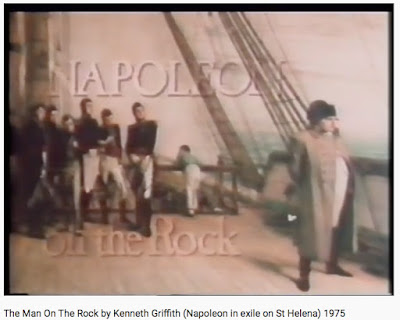
The Man on the Rock - Kenneth Griffith (1975)


On our recent visit to St Helena we were privileged to be able to watch this powerful performance by Kenneth Griffith on a large screen. It first appeared in 1975, but has long since been forgotten, and it was difficult to find a copy. We were surprised and pleased to find that it is now available on youtube

Click Here To View .

It was filmed on St Helena and one of my friends on the island remembers Griffith coming to the local amateur dramatic group on a number of occasions during his stay.

Griffith plays Napoleon's gaoler Sir Hudson Lowe as well as Napoleon, which is a remarkable achievement in itself. His portrayal of Lowe is at times rather amusing and after half a century and much scholarly activity still seems an accurate one.

Any recent visitor to St Helena will note how the presentation of the French Properties has greatly changed since the film was made.

It is very highly recommended viewing for anyone interested in the captivity of Napoleon.

Thursday, 17 March 2022

Sir Hudson Lowe and Antonomasia - A Review


Sir Hudson Lowe, Victime of St Helena by Michel Dancoisne-Martineau

This book, one of a series of 12, is only available from the Longwood House souvenir shop on the island of St Helena. It contains parallel French and English text, as well as numerous pictures, newspaper cuttings and historical documents. The author rivals Napoleon in his capacity for hard work, and has over the years done a tremendous amount of research on his subject, rather more than is normal for such a book, as the 369 footnotes testify.

From relatively humble origins, Lowe received the job of guarding the most illustrious person of his age, and probably of many ages, and this gave him an inflated sense of his own importance. He came to believe that he was at least Napoleon’s equal, and perhaps his superior. With an undistinguished military career, Lowe had gained for himself a reputation for good foreign language and writing skills. His promotion was based on his abilities as an administrator and an observer, on his loyalism and obedience, and on the fact that nobody of suitable rank could be found to carry out such an assignment.

The author provides an apt judgement on why Sir Hudson Lowe was such a good choice for the Lord Bathurst and the British Government.

“.. the man Bathurst needed to subject Napoleon to the petty restrictions, even humiliations, he wished to inflict on him, without exposing himself to the opprobrium of opposition and history. Two centuries after the events, the appointment of a civil servant reputed to be meticulous, undiscerning, quarrelsome, vain, petty, zealous and stubborn looks like a fool’s bargain. If one had to decide who was to blame, one should probably look to those who invited him to the table of the great and powerful.”

Flier for Exhibition at Plantation House, St Helena, cut short by decision of the present Governor's wife!

The book reveals a sound knowledge of the British or more accurately English society from which Lowe sprang: a highly ordered, corrupt society dominated by a small oligarchy, ruthless in its suppression of dissent and desirous of turning back the ideas of the French Revolution of which Napoleon had become the symbol. It correctly identifies Lowe as an ultra-loyalist Tory, whose political views would have been reinforced by his association with the absolutist continental rulers to whom he was often attached during the wars against Napoleon. He was in short the most loyal of subjects of George III and the Prince Regent, and of the aristocratic world in which he thought he had secured a foothold. In his entourage on St Helena he sought people with similar views to himself, and was most suspicious of those known to be sympathetic to the Whigs and to Napoleon.

The study takes issue with those who see Lowe as a vindictive gaoler as well as those who see him as the victim of cruel manipulation by Napoleon and his entourage. It paints a picture of a well meaning but flawed man, appointed to a job for which he was not suited, who let his sudden promotion rather go to his head, and who was never able to free himself from the delusions acquired from his appointment. Much of the material is new, particularly for the period after his return from St Helena when Lowe was never able to get a senior position that matched the St Helena appointment, and had to withstand increasingly unpleasant and often public shows of unpopularity, which the author describes as “mobbing”.

The most astonishing revelation of this study was the amount of wealth that Lowe gained from his five years in charge of Napoleon, despite losing a significant amount from fraud. As this book explains, this helped reinforce the delusion which was a feature of his conduct both on St Helena and after. In 1824 he continually changed his mind as to whether to accept the post of Governor of Antigua, and his frequent changes often appeared to be related to decisions of the local Assembly to lower and then raise the salary. Despite not taking the job he still submitted an account for £302 for expenses, around £27,000 in 2018 money! The author also reveals Lowe’s attempts to get back-pay from the East India Company as well as pay for the year after he left the island. The Company resisted, but for some reason the British Government in the person of Lord Bathurst acceded to his wishes.

Perhaps the most telling and amusing part is the account of his ten months long ostentatious overland journey with his family from Paris to Ceylon to take up his appointment as Lieutenant Governor, in the forlorn expectation that he would shortly thereafter receive the appointment as Governor. During the whole of this trip Lowe basked in the temporary title the Govt had given him of Lieutenant General of His Gracious Majesty, but he was not always as well received as he wished in the capitals of Europe. In Vienna the Emperor Franz refused to see him, and Metternich encouraged him to leave the city where Napoleon’s son then resided!

Among the belongings auctioned after his death was a lock of the King of Rome’s hair, the subject of over 1000 pages of correspondence while he was on St Helena, which had supposedly been destroyed. There were also other articles bearing inscriptions “N” and “Emperor” which would have got anyone severe penalties had they been written by anyone on the island during Lowe’s term as Governor.

Finally, I have learned a new word from this book, antonomasia, the use of a proper name to describe the characteristics of a person. According to Hazlitt (1826) a “Sir Hudson Lowe” is someone who appears

“ so much the creatures of the head and so little of the heart, they are so cold, so lifeless, so mechanical, so much governed by calculation, and so little by impulse …”.
Such was Lowe’s reputation that the term was even used in the House of Commons during Lowe’s lifetime.

This is an important, well researched book. It is a pity that it is so difficult to obtain.

ps. I also learned that Sir Hudson Lowe was a couple of centimetres shorter than Napoleon! The British propaganda about Napoleon's height is a subject I have often referred to over the years!.

Saturday, 15 January 2022

Queen Victoria and the Empress Eugénie


Queen Victoria's portrait of Eugénie, May 1855

By the last decades of the nineteenth century the Bonaparte family had gained legitimacy among Europe's rulers. No longer identified with opposition to the British oligarchy and its absolutist allies on the continent, they had become part of the established order, allies against Republican and working class movements which increasingly put fear into the heads of Europe's ruling classes.

The Bonapartes themselves exhibited a certain sense of entitlement, all the more curious since their claims derived entirely from the upstart Emperor, exiled on St Helena and insultingly referred to as "General Bonaparte" by his British gaolers. At least one of the family, Mathilde Bonaparte (1820-1904), daughter of Napoleon's brother Jerome, recognised this, apparently telling Marcel Proust that if it weren't for her famous uncle she would be "selling oranges in the streets of Ajaccio, " but there is no evidence that it made her feel any less entitled.

One of the Bonapartes, Prince Louis-Lucien(1813-1891) was apparently devoted to Queen Victoria. She always addressed him as Imperial Highness although he had no right to the title. According to his cousin Caroline Murat he lived so long in England and had "became almost an Englishman", and a rather conservative one at that. (1) Having met Gladstone at Eugenie's he commented "I didn't know a Liberal could be a true gentleman". (2) The closest relationship though was between Queen Victoria and Eugénie, Empress of the French (1826-1920).


Franz Xaver Winterhalter's portrait of Eugénie, Empress of the French, copied by Mary Curtis in December 1855 for Queen Victoria

The world in which Victoria and Eugenie became friends was very different from that of the first Napoleon. Britain was at the pinnacle of its global power, and the centuries old struggle with France had come to an end, although not everyone had noticed it.(3) The Enlightenment ideas with which Napoleon was identified, the rights of property, secularism and legal equality had for the most part become mainstream among the English ruling class, and most of England's rulers still shared Napoleon's distrust of democracy.

Victoria and Albert with Napoleon III and Eugénie, London 1855

Queen Victoria had been told in 1850 by Lord Aberdeen that the future Napoleon III had good manners and was " very quiet, not at all French " (4), which perhaps reconciled her to the fall of King Louis Philippe, "the one person fitted to govern such an unmanageable people. " (5).

Over a decade earlier, before Napoleon's body had been brought back from St Helena she had been sent a book by her uncle the Duke of Sussex, a well known Whig supporter of Napoleon. The book had suggested to her the almost treasonous thought that "Napoleon's wars were good " and disabused her of the belief that he had been a coward. (6)

Initially opposed to Louis Napoleon's coup, in October Victoria recorded that the Govt formed was of "people who are nobody". By December though she rejoiced at the big majority that Louis Napoleon had gained in the French elections, "as a sign of moderation" and "a stepping stone to something better". (7)

Napoleon III, Eugénie and the Prince Imperial

Her soon to be friend, the Spanish Princess Eugénie de Montijo, had married Napoleon III in 1853, and their first meeting was in 1855 when she and her husband were guests in London during the Crimean War. Shortly after Victoria returned the visit and in Paris was taken to see the tomb of "the great Napoleon".

Franz Xaver Winterhalter's portrait of Eugénie, Empress of the French, copy by Johann Horrak.

In her diary of December 24th, 1857 commenting on her Christmas presents Queen Victoria singled out a gift by "Dearest Albert" of "a copy of Winterhalter's picture of the Empress Eugénie in a straw hat, which I am so particularly fond of, and which is charming."

After the overthrow of the Second Empire Victoria visited the Empress and her son in Kent where Eugénie "very thin & pale, but still very handsome", with "deep sadness in her face" and frequent tears in her eyes, spoke of her dreadful last hours in Paris as the populace stormed the Tuileries. (8)

After Napoleon III's death the Empress gave Victoria a photograph of him and his travelling clock which had accompanied him everywhere and was beside his bed when he died. Victoria showed it to Eugénie when the latter visited, and wrote in her diary: "Now it stands in my sitting room, & I shall always take it about with me, & leave it as an Heirloom to Windsor!!!" (9)

Most devastating of all was the tragic death of Eugenie's only child, the Prince Imperial, while serving with British troops in South Africa. Victoria heard the news before Eugénie, and may have felt some responsibility for it. She recorded that it haunted her all night "seeing those horrid Zulus constantly before me", and "thinking of the poor Empress who did not yet know it." (10) Her diary gives a very detailed account of the Prince Imperial's funeral where she met all the assorted Bonapartes, most of whom she seemed to have some knowledge of,

The Princes & Psse Matilde came in here, & the different Princes were presented by Pce Napoleon, who has very civil, & very subdued & embarassed. Psse Matilde, I found very little altered At the door, we were met by Ld Sydney Psse Matilde (whom I had not seen since 55, in Paris) Pce Napoleon, with his 2 sons Victor & Louis, Pce Lucien Bonaparte (the savant, who always resides in England) Pce Charles Napolén Bonaparte (his, nephew) Pce Murat, his daughter Psse Eugénie, & his brother Pce Louis, the Duc de Bassano & others. Pce Napoleon is aged, & grown balder, & more like to Napoleon I than ever. His eldest son Victor, is tall & nice & intelligent looking, very like the Italian family, but with the fine Bonaparte brow, & complexion. The 2nd, is much shorter & darker, & has quite the Bonaparte features. Pce Lucien, is grey & old looking, very pleasing, & gentlemanlike. He loved the dear young Prince dearly & feels his death acutely. He is the son of Napoleon I's eldest brother. He was present at the painful identification & said "Mais, je l'ai reconnu!" His nephew, Pce Charles, I had never seen before, a good looking elderly man, whose mother, was the daughter of Joseph Bonaparte, King of Spain. Besides these, there was Pce Murat's handsome daughter Eugénie & his younger brother Pce Louis. — (11)

In her widowhood the Empress Eugénie, often referred to by Victoria as "dear Empress Eugénie" and sometime "poor Empress Eugénie ", was a frequent visitor to Osborne House, Balmoral and Windsor. Occasionally Victoria visited her, including a couple of visits to Eugénie's villa, "Cyrnos" in the South of France. Victoria sometimes lent Eugénie a cottage at Osborne house, and also another one in Abergele in the Scottish highlands. In Osborne House gardens were some violets brought back from St Helena in 1880. (12) Sometimes other members of the Bonaparte family accompanied Eugénie on her visits.

Eugénie at her villa, Cyrnos, in the South of France

On one occasion the two friends visited the Demidoff villa in Italy, former home of Anatoly Demidoff (1813-1870), and his wife Mathilde Bonaparte. Victoria noted that

there were busts of the Empr Napoleon & Empress Eugénie, also a bust of myself, which I cannot understand how he got. Took tea, which we had brought with us, in one of the small rooms, & afterwards went up into a magnificent drawing room, which was full of fine & interesting things, amongst others the clock, which had stood in the room at St. Helena, in which Napoleon I died. There was also death mask of him. (13)

Funeral in 1820, attended by King and Queen of England and the Queen of Spain

Bonapartism as a political force effectively ended with the death of the Prince Imperial in 1879. Thereafter the Orleanists became the better bet for the enemies of Republicanism. (14) Nevertheless Victoria's relationship with the Bonapartes remained unbroken. In 1886 she saw the "monstrous" proposal by the French Govt to expel the Orléans & Bonaparte Princes as directed at Prince Napoleon and his son Prince Victor. In the final months of her life she was visited by Prince Napoleon and his brother Princce Louis, who she noted had been serving for some time in the Russian army, which happened to be governed by another Emperor and another relative of hers. (15)

Eugénie lived to see Victoria's son and then grandson on the throne, and then through the First World War, which destroyed much of the old European order. She died in 1920 on a final visit to Spain, the nation of her birth. Like Napoleon I she had two funerals, one in Madrid, and then her body was returned for burial in England. Her English funeral was attended not only by assorted Bonapartes, but by the King and Queen of England and the Queen of Spain.
-----------------------------------------------------
1. My Memoirs The Princess Caroline Murat (New York 1910) p. 80
2. Murat p 24
3. There was a war scare in Britain after Napoleon III came to power.
4. Victoria Diary, 6th Feb 1850.
5. Victoria Diary 14 August 1839
6. Victoria Diary, 14 Aug 1839
7. Victoria Diary, 31st Oct & 14 Dec 1848.
8. Victoria Diary 30th November 1870
9. Victoria Diary Osborne House 26th January 1873.
10. Victoria Diary, Balmoral Castle, Friday June 20th 1879)
11. Victoria Diary, Windsor 12th July 1879
12. Victoria Diary, 22 December 1881.
13 Victoria Diary, Florence (Villa Palieri). 19th April 1888
14. "Courts in exile: Bourbons, Bonapartes and Orléans in London, from George III to Edward VII" Philip Mansel in A history of the French in London, ed Debra Kelly & Martyn Cornick, p 118. Institute of Historical Research (London 2013)
15. Victoria Diary 4th June 1886 & 22 November 1900.

Saturday, 12 June 2021

Queen Victoria, Count Walewski and a Famous Painting


Napoleon at Fontainebleau, 31 March 1814 Paul Delaroche

There appear to be a number of versions of Delaroche's painting of Napoleon's first abdication. One has been in the Musée de l'Armée in Paris since 1954. (1) Another resides in the Royal Collection.

In 1852 the painting was viewed at Windsor by Alexandre Walewski (1810-1868), Napoleon's natural son, now French emissary to the Court of St James. Victoria entertained Walewski and his wife a few days after the British Government had officially recognised Louis Napoleon as Emperor of the French!

The Walewskis & Lord Malmesbury to dinner, the Count, sitting next to me. He was very amiable & talkative, speaking immediately, & in great admiration, of the fine picture we have here of Napoleon at Fontainebleau, by P. Delaroche. The Counts own likeness to Napoleon is very striking, & if there was a doubt of the relationship, the fact of his appearance is an infallible proof. (2)

Alexandre Walewski (1810-1858)

Queen Victoria got to know Walewski and his second wife very well. In the early year things were rather strained. She was concerned that Lord Palmerston had expressed his approval to Walewski of the coup in which Louis Napoleon had seized power, which cost Palmerston his job. She also refused to give her support to the proposed marriage of Napoleon III to her niece, Princess Adelheid of Hohenlohe-Langenburg.

In her diary she commented on Walewski's lack of tact, and later described him as a rogue when he appeared to criticise Napoleon III, for whom after a rather hostile start, the Queen came to develop a surprisingly close attachment.(3) She also was very well aware of Walewski's relationship with the promiscuous actress Rachel, who had a few years earlier borne him a daughter:

The latter was full of awkward "mal à propas", being famous for want of tact. He is most anxious our Fleets should have an opportunity of acting together, — enquired after the Orléans family, — spoke of Rachel, whose former liaison with him is notorious! &c(4)

A year or two later, during the Crimean War,in which the two great enemies were for the first time allies, Victoria entertained Napoleon III and the Empress Eugenie, with whom she was to forge a long lasting friendship. The meeting was a great success, but Victoria could not help appreciate the irony of entertaining a nephew of Napoleon:

Then dancing began, I, dancing a Quadrille with the Emperor, Albert opposite, with the Empress. This was followed by a Reel, in which Vicky danced very nicely, then a Valse which the Emperor asked her to dance with him, & which frightened her very much, &c — Really to think of a Gd Daughter of George IIIrd, dancing with the nephew of our great enemy, the Empr Napoleon now my most firm Ally, in the Waterloo Gallery, — is incredible! And this Ally was only 6 years ago, an exile in England, poor, & not at all thought of! The Emperor led me in to supper & Albert, the Empress. Her manner is the most perfect thing I ever saw, so gentle, graceful & kind, & so modest & retiring. All was over by ½ p. 12. Vicky behaved extremely well, making beautiful curtseys & was much praised by the Emperor & Empress, about whom she raves.(5)
A few months later Victoria was in Paris, the first British monarch to go there for four centuries, and whilst there paid her respects before the tomb of the "Great Napoleon"!


----------------------------------------------
1. The Musée de l'Armée version, was bought by the Liverpool industrialist John Naylor, and was for years part of the Naylor Collection in Wales. An article published by theNapoleon Foundation says it was bought and donated to the Museum by Francis Howard, the Founder of the Grosvenor Art Gallery in London, a European educated American, the great grandson of Benjamin Franklin.
2. Queen Victoria's Diary, 9th December 1852. DNA has now confirmed Victoria's judgement that Walewski did descend from the male Bonaparte line.
3. Diary, 10th June 1853, 4th September 1859.
4. Diary 10th June 1853.
5. Diary 17th April 1855.

Friday, 21 May 2021

The Bicentenary: An Update


Napoleon's Grave, St Helena, May 2021

After years of preparation, the disruption of the pandemic and the debate in France over Napoleon's legacy, the ceremonies on St Helena have now passed.

In my previous post I said that the commemoration would be very different from that in 1921. It didn't take any special foresight to say that! Commemoration of the bicentenary took place in a world perhaps even further removed from 1921 than that era was from 1821.

In the shadow of the Great War, most if not all of the imperial certainties of a European dominated, Atlantic centred world remained. That era has now long gone. The UK has moved on from Empire to Commonwealth, and now, after a brief semi-detached sojourn in the European Community, in the midst of a global economic and environmental crisis, to the Anglosphere and "Global Britain". One wonders what our descendants will make of that in 2121. One wonders also what place St Helena will have in this new world.

Tuesday, 4 May 2021

May 5th: Thoughts on the Bicentenary of Napoleon's Death

The Centenary of Napoleon's Death, St Helena 1921

Napoleon's Tomb, St Helena

Despite the pandemic an impressive programme has been planned on St Helena both at Longwood House and around the empty grave. It will be a very different atmosphere from a century ago. I will be surprised if the Union Jack is flown as it was in 1921, and I expect a low key, more informal ceremony with the participation of many ordinary Saints, few if any of whom appear to have been present a century ago.

In Paris President Macron has somewhat controversially decided to lay a wreath beside Napoleon's tomb in Les Invalides. It will probably come as a surprise to many English patriots to find that Napoleon is not universally admired in France. At the risk of over-simplification his memory is more revered on the political Right than on the Left! Macron of course is a centrist.

Macron's aides have let it be known that "Someone at the start of the 21st century does not think like someone at the start of the 19th century. Our history is our history and we accept it. "

The novelist L.P. Hartley put it more succinctly:

The past is a foreign country: they do things differently there.

With that in mind I have decided to return to what has been a major theme of this blog: the surprising amount of support for Napoleon in England, in folk songs, in people christening their children "Napoleon", and in the political campaigns of the Radicals, not to mention the better known but more measured support from Lady Holland and the Foxite Whigs.

"The most wonderful man that ever existed"

Henry "Orator" Hunt, the radical leader who was imprisoned after the Peterloo Massacre in Manchester, on hearing of Napoleon's death wrote these comments from Ilchester Jail. (1)


For Radicals Waterloo and Peterloo were of one piece - to cement the hold of autocratic rulers against the forces of liberty on the continent and in England.

Curiously on St. Helena Napoleon spoke of Orator Hunt, and it is fair to say that he did not have that much sympathy for his cause, which he seems to have identified with mob rule from which he believed he had saved France. He marvelled though at the ability of the English aristocracy to laugh at liberty and at freedom of the press. (2)

On Hudson Lowe, Napoleon's Gaoler: "very unlike the English to have behaved like that"

Finally a few comments by Queen Victoria, just under two years old when Napoleon died, but clearly schooled by the Whigs! On hearing of the death of Hudson Lowe in 1844 she wrote:

Sir Hudson Lowe has just died. He was chiefly renowned for his custody of Napoleon at St. Helena, which he is said to have performed with great harshness.(3)

Napoleon she considered was "one of the most remarkable men in the world's history, though not the best.(4) A few days later she added:

Sir Robert Gardiner has no good opinion of Sir Hudson Lowe & says his treatment of Napoleon was most unfeeling & harsh, & that altogether the way in which he was treated at St. Helena, was abominable & disgraceful, & most ungenerous towards a Captive of such note as he was. I must say I think it is very unlike the English to have behaved like that.
(5)
------------------------------------------------------------------
1. To the Radical reformers, male and female, of England, Ireland, and Scotland p. 238-239.
2. Napoleon at St. Helena, Memoirs of General Bertrand, Grand Marshall of the Palace January to May 1821 (London 1953) p. 71.
3. Queen Victoria Journal, 12th January 1844.
4. ibid .
5. Queen Victoria Journal, 15th January 1844.